
Meet Erik Möller, Norditek's Aftermarket Manager

Since last September, Erik Möller has been the aftermarket manager at Norditek. In this role, he ensures that customers receive the right assistance, clear feedback, the right replacement parts, and the right support once the machine is installed.

“I’ve worked in a variety of roles in the Gothenburg region, mostly within the Stena Group, and most recently served as aftermarket manager at Malwa Forest in the forestry industry—a sector with many similarities to Norditek,” Erik explains. In his free time, he lives on a farm where he builds and repairs whatever he needs himself, and hunting is his greatest passion outside of work.

Erik was familiar with Norditek long before he joined the company. Through previous contacts in the industry, he had seen the machines in operation and had casual conversations with both service partners and Norditek’s former aftermarket manager.


Large machines and a genuine commitment to recycling

Ask Erik what drew him to us, and his answer comes in two parts. One is personal, and the other is a matter of principle.

“Big machines that rumble and tear things apart—I think that’s really fun,” he says. Straight to the point, just like the machines he’s talking about.

The second part carries more weight. Erik believes that Sweden needs to do a better job of recycling the materials that are already available, rather than continuing to extract new ones.

“We have vast amounts of material that we need to be able to recycle in one way or another. I think it’s meaningful to be a part of that process.”


An installed subwoofer full of potential

A few months into the role, Erik’s first major insight was as simple as it was interesting: Norditek already has a large and well-established installed base, with significantly more potential than is currently being tapped.

“We can build and develop services that help customers make more money with Our ’s help.” That insight is now driving much of his focus moving forward.


What “good after-sales service” means to our customers

“They should feel that Norditek is a reliable, trustworthy supplier that is always there for them and understands both their day-to-day operations at the facility and their business. Customers should think: ‘If we contact Norditek, we’ll get the best help.’ Whether the machine was purchased new, rented, or used.”

In practice, it should be simple and clear. Continuous feedback throughout the entire process, a focus on maintaining uptime, and helping to optimize the machine. With information that is clear enough for the customer to find the right replacement part on their own, without having to call and ask.


The most common problems Erik wants to help customers avoid in their production

When a machine isn't working as expected, Erik wants to get to the bottom of why, not just patch it up and fix it.

“Is there a problem with the material we’re feeding into the machine? Is there a technical problem with the machine itself? Is the machine being used as configured, or does it need to be optimized?”

Questions that guide both troubleshooting and the long-term effort to get more out of each machine.

If you ask Erik what he started with during his first few months, the answer is neither glamorous nor surprising—but all the more important.

“When I started here, I conducted an analysis of the current situation: what we do, who does what, how we do it, and how we manage it financially. The foundation must be stable before we can build on it, and that is exactly the work we are starting with right now.”


The aftermarket's role is a central pillar, not a support function

Erik views the aftermarket as a key pillar of Norditek's business, alongside sales.

“We need to understand our customers’ businesses and tailor our offerings so that both the customer and we benefit, with a focus on creating a win-win relationship.” The aftermarket should focus on what delivers direct business value and leave the rest aside. According to Erik, that’s how you lay the foundation for a lean and efficient organization with low overhead.


From the farm to the machine shop

Development and improvement are things that are fun to be a part of, and it’s great to be the one who helps make the vision a reality.

It’s evident in his personal life, too. Erik has a keen personal interest in machinery; he lives on a farm where he’s building a machine shop himself, welds together tools that aren’t available for purchase, and repairs his own car when needed. “I’m not exactly all thumbs, so to speak.”

That practical perspective carries over into his work and into Norditek Academy, the new training initiative for operators that Erik runs in partnership with SSG. Watch this space.


A good week is one where Erik is hardly needed

If you ask Erik what a good week looks like, you'll get an answer that many managers would agree with:

“In a really good week, I shouldn’t actually have to be very involved in day-to-day operations. That’s when orders come in smoothly, customers are satisfied, and I can spend my time developing new solutions that meet our customers’ needs even better.” He laughs at his own wording: the goal is essentially to phase himself out of day-to-day operations.

Of course, reality rarely looks like that. But the course has been set, and for Norditek’s customers, that means an aftermarket that is on its way to becoming exactly as comprehensive and precise as Erik wants it to be.


Would you like to get in touch with Erik, express interest in receiving information about Norditek Academy, or learn more about Norditek’s aftermarket? Please contact Erik

What's happening at the Norditek Recycling Lab?

To provide more and better answers to the question of how materials that are currently often classified as waste can contain value, the Norditek Recycling Lab has been expanded. Not only does it now have a larger space for experiments, but it also features an industrial furnace, equipment, and better capabilities for conducting in-depth testing of a wider range of materials.

This means we can provide our customers with concrete answers before they make investment decisions.

Linnea is in charge of our lab and all material testing. She helps our sales representatives answer customers’ most important questions. Once we’ve worked with the customer to identify that a material has potential, we dive into the details.

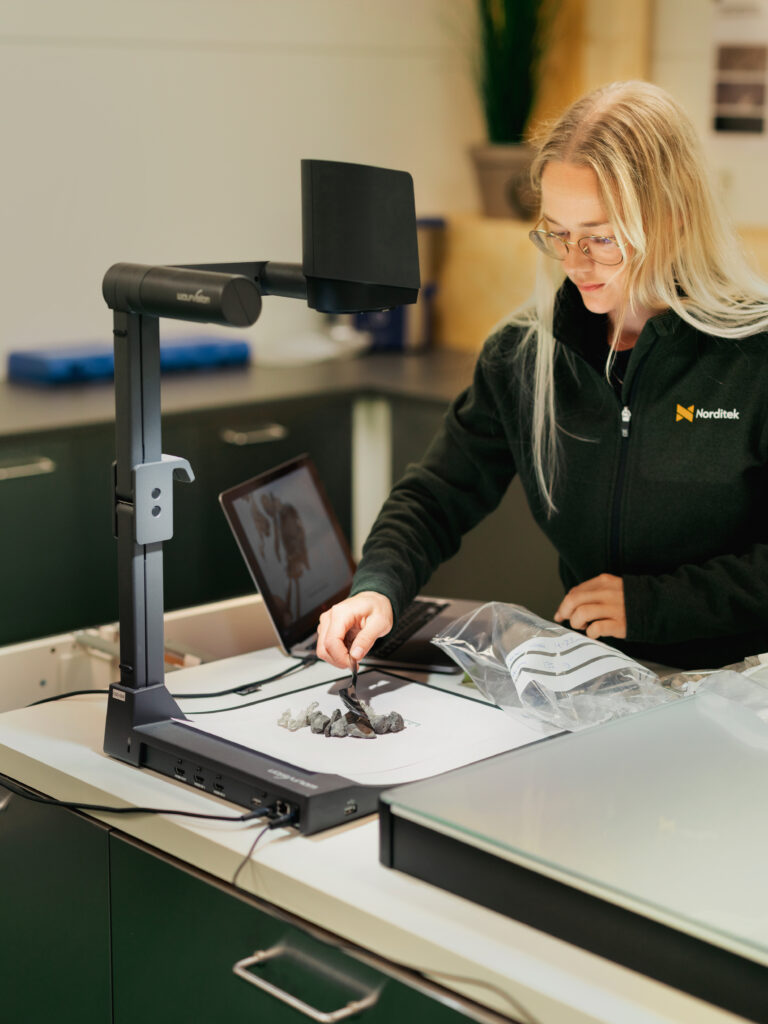
Linnéa Bjöörn, a Test and Development Engineer at Norditek, is conducting a material analysis at the Norditek Recycling Lab.

• What is the material made of?

• How does it behave?

• What can be separated?

• Which fraction has a value?

• And what solution is needed to process the material in the best possible way?

In the lab, we test our customers’ materials in detail to understand what they contain, how they react, and what technology is needed to take the next step. Because sometimes the difference between waste and raw material comes down to the right test, the right particle size, and the right combination of modules.

Right now, everything from construction waste, the iconic hybrid grass from Ullevi, and fiberglass to twig nuts, gypsum paper, and various types of sand is being tested. Each material has its own challenges. Rolled sand requires the right mesh size in the screen. Twig nuts need to be tested to see if they can be incinerated. With the new industrial furnace, we can investigate whether materials can be used as backfill, where the amount of organic material must be reduced to the correct level to ensure stability.

That might sound nerdy? Yep, it is. For us, however, it’s about something very concrete: helping our customers reduce uncertainty before they invest in a solution, lower opportunity costs, and find value in materials that might otherwise become an expense.

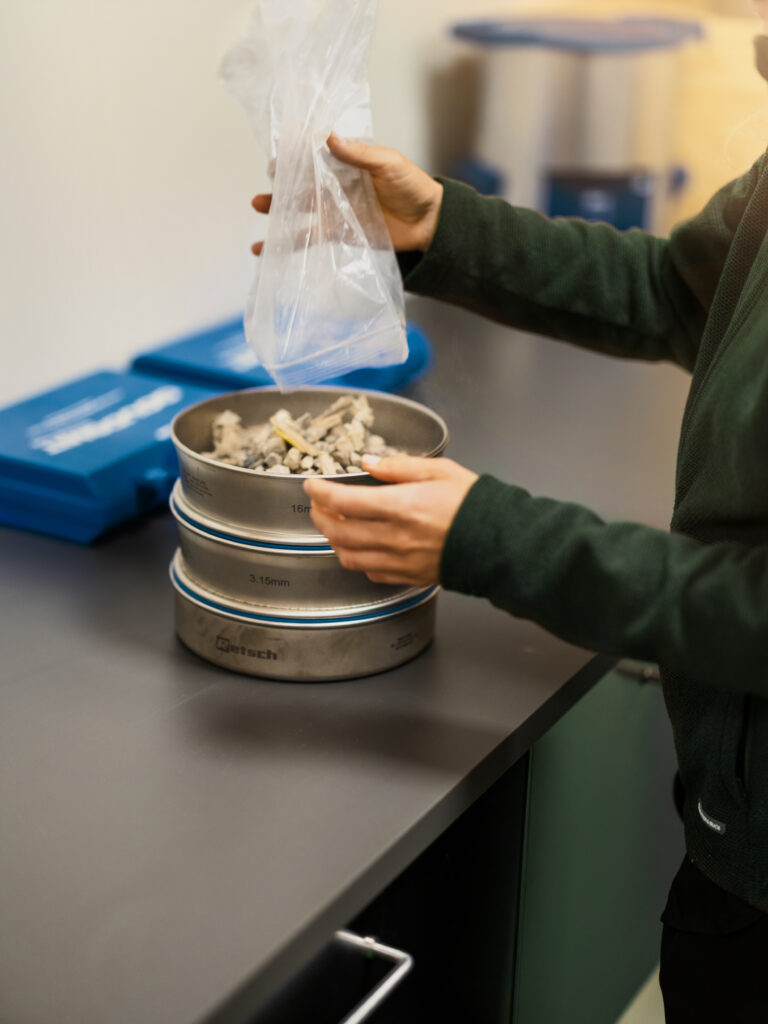
Most material analyses are conducted on a representative sample of just 1 kg of the material.

How does it work?

A material sample, weighing about 1 kg, is sent to the lab. Linnea and the salesperson decide which tests are most relevant for answering the questions about that specific material.

The results are compiled into a report that outlines the material's composition, weight, and size, as well as the available options and which modules can be combined to create the greatest possible value.

Not a guess. Not a one-size-fits-all solution. But a system based on the material’s actual composition, behavior, and potential.

Because materials can go from being a cost to a raw material, the business begins right in the lab.

Not sure about your materials?

We're here to help you every step of the way. By analyzing a material sample, we can both identify the material's value and determine the settings that yield the highest possible purity—and thus a higher final value.

Contact us today for a material analysis. Try it first, then choose!

New regulations in the " the wind shifter"—what does this mean for your facility?

In recycling, every material stream is unique. What works for one material may not work for another. That is why a windshifter must be able to adapt quickly, precisely, and in a way that works in actual production.


Norditeks' windshifter is now even easier to use.


With a new feature for saving settings—which we call “recipes”—the operator can save, reuse, and share settings for different materials. This makes it faster to switch materials, easier to find the right settings, and simpler to produce a clean, high-quality finished product.


From manual settings to saved recipes

The major change in Norditek's windshifter is that settings can now be saved as recipes.

This means that the operator can set up the machine for a specific material, save the settings, and then easily revert to the same recipe the next time that material is processed.

Everything is controlled via the display. Instead of manually adjusting multiple parameters, the operator can work within a single interface and change the settings with a few simple button presses.

For facilities that handle multiple material streams, this means a more predictable day-to-day operation. It becomes easier to get started, easier to switch materials, and easier to avoid unnecessary production stoppages.


A " windshifter " that is preset from the start

windshifter with scalability settings


An important part of the recipe feature is that Norditek can configure the machine before it is shipped to our customers.

The process often begins with a material sample. The customer sends material to us at Norditek; we analyze its composition, examine what the material consists of, and assess the potential value of the material stream.

Based on the material test, we can determine the correct settings for the wind shifter and include them as instructions.

For our customers, this means that the machine is essentially ready to go from day one. The correct settings are already in place, tailored to the material being processed.
This reduces the risk of incorrect settings, saves time during startup, and makes it easier to achieve the right quality right away.


Easier to switch materials during production

Many recycling facilities do not handle a single stream of materials. They receive different materials at different times, from different customers, and with varying compositions.

For example, a larger facility may process one type of material for several weeks and then switch to an entirely different material flow. In such cases, the machine must be able to be quickly reconfigured without production slowing down.

With recipes in the " the wind shifter ," the plant can save settings for different materials and switch between them as production changes.

It makes a big difference in day-to-day operations. Instead of starting from scratch every time the material is changed, the operator can use a proven recipe as a starting point, make minor adjustments as needed, and quickly return to the correct operating mode.


Share recipes across multiple wind sifts

For customers with multiple machines, the value increases. Recipes can be exported and shared among different wind sifters. This means that settings that work on one machine can be used as a starting point on another.

This is particularly valuable when a facility has multiple production lines, rented machinery, or machines that are moved between different locations.

For example, if a customer switches from a rental machine to a new windshifter , the recipes can be transferred along with it. Once the new machine is in place, production can get underway more quickly, with settings that have already been tested and documented.


More control for those who want to optimize the profitability of their facility

The recipe feature in the wind shifter isn’t just about making work easier. It also makes it easier to take a more systematic approach to optimization.

An operator can test a new setting, save it as a new recipe, and compare the results with previous settings. If the results aren't any better, it's easy to revert to the previous recipe.

This makes it possible to explore the machine’s capabilities without losing control.

For facilities looking to increase cleanliness, improve capacity, and get more value out of their material flow, the wind shifter becomes a more effective tool for improvement efforts. Not just another machine on the line.


Developed based on real needs

The recipe feature was developed to solve a practical problem in customers’ daily lives. Previously, settings sometimes had to be documented manually—for example, through photos—in order to be recreated or shared. It worked, but it wasn’t particularly scalable.

With recipes, the work becomes more standardized, more predictable, and easier to track.

Albin Lindgren, a product developer at Norditek, helped develop this feature. His work involves listening to customers’ needs, prioritizing the right development efforts, and working with mechanics and engineers to turn ideas into practical solutions. The goal is simple: to make customers’ daily lives easier and their materials cleaner.


Progress doesn't stop at the wind shifter

Norditek’s test lab has been given a complete overhaul. The new machine hall offers 700 square meters of space for testing, demonstrations, and material analysis. It houses one of each module in the portfolio, making it possible to test real materials in real machines.

This means faster tests, better information for decision-making, and more accurate recommendations for customers who want to understand the potential of their material. For anyone looking to optimize their facility, that’s often where it starts—with the material, with the test, and with the right settings in the right windshifter.


Would you like to learn more about how the wind shifter can be used at your facility?

We’ll help you see the possibilities in practice—from flexible modular systems to wind sifting and how the technology works within your workflow.

Get in touch with us and let us help you unlock the potential of your material flow.

Global Demand for Smarter Recycling: A Look at Norditeks’ Four Days at IFAT

Four days, one Munich, and a message that was hard to miss: recycling and the circular economy are no longer a niche interest. That’s the direction the entire industry is heading—in Sweden, in Europe, and globally.

Norditek was on-site at IFAT, the world’s leading trade fair for environmental technology and recycling, to meet with existing and new contacts. What we’re taking home with us is clear: the demand for smarter, more precise recycling is growing, and Sweden is at the forefront.

Another Way to Talk About Recycling

Thereza, a sales support representative at Norditek, was on hand at the booth all four days and met with resellers, facility owners, and operators from around the world.

“We take a different approach, and that makes the dialogue more focused on the results the customer wants to achieve, not on the machines,” says Thereza.

The difference may sound simple, but it makes a big difference in practice. Many suppliers in the recycling industry start the conversation by discussing technology and machine specifications. Norditek does the opposite: we start with the material. What kind of waste stream are we dealing with? What fractions can be recovered? What is the actual value of what is currently classified as waste?

That approach generated a great deal of interest at the booth and is also the reason why discussions with international visitors quickly led to concrete solutions.

Sweden as a Role Model in Circular Materials Management

A clear trend at the trade show was how many countries are currently in the early stages of the same journey that the Swedish recycling industry has already embarked upon.

“Many people said that it feels reassuring to talk to us in Sweden, especially when it comes to our solutions. Several countries are behind us and are now set to embark on the journey that Sweden has already taken in the field of circular materials management,” says Thereza.

EU regulations play a major role here. Stricter requirements and upcoming regulations, such as the Circular Economy Act, are driving this development and prompting more players in the recycling industry to actively seek solutions to better process their materials.

“It’s clear that many people want to catch up. For them, the next step isn’t just about buying a machine, but about understanding their material, seeing the potential in the workflow, and having the courage to invest in a solution that will stand the test of time,” says Thereza.

From Curiosity to Solution: Right at the Booth

A concrete example from the trade show illustrates how Norditek’s approach works in practice. A German company visited the booth with questions about a specific material—one that had already been tested at the Norditek Recycling Lab in Fjärås.

Since there was already a completed material report on that specific material, the conversation was able to move directly from curiosity to a concrete solution proposal, without any detours. This is a good example of why we believe that recycling should start in the lab and with the material’s potential, not in the machine catalog.

The development of an international recycling network continues

The work doesn’t stop in Munich. The next step for Norditek is to continue expanding its international dealer network, market by market, and invite new partners to Fjärås for training in our approach, Our technology, and our long-term vision for recycling.

The goal is simple: no matter which country a customer is in, they should be met with the same approach—starting with the material, understanding its value, and finding the solution from there.

Interest extends far beyond Europe's borders. During and after IFAT, Norditek has engaged in discussions with stakeholders from the United States, Canada, India, and Australia, among others.

“There was a great turnout from both Swedish and international customers. We had several retailers from different countries on hand at the booth, which meant that end customers could get assistance in their own language. That set the stage for a productive dialogue right away,” says Thereza.

A fun industry with great potential

To sum up the mood after four days in Munich:

“It’s an exciting industry, and there’s a lot going on right now. There’s a lot of interest in Norditek and our processes. That means there’s great potential, especially as the focus on circular materials management continues to grow,” Thereza concludes.

Norditek is returning from IFAT with a great deal of energy, new contacts, and even more exciting discussions, and will continue its work to make recycling easier, smarter, and more profitable for facilities, no matter where in the world they are located.


Would you like to learn more about how Norditek Recycling Lab can help your facility understand the potential of your material streams? Contact us to discuss this further.

Waste – Is It a Hidden Asset in Your Production?

This article explains what residual flows are, how they arise, and why it pays to take them seriously—both financially and strategically.

What is a residual flow?

A residual stream is a material stream that arises as a byproduct of a business process and is not included in the primary product. It may be:

  • Production waste – excess material from cutting, casting, or machining
  • Rejected products – defective items, returns, or products that do not meet requirements
  • Process residues – slag, ash, sludge, or filter cake generated during purification or incineration
  • Packaging waste – pallets, packaging, or cardboard
  • Demolition and construction materials – concrete, brick, wood, and metal from renovations or demolition

What all waste streams have in common is that they have inherent value—they contain raw materials, energy, or functionality that can be recovered if handled properly.

Why are residual flows ignored—and what is the cost?

The most common reason is simple: historically, waste materials have been viewed as acost center, not as an asset. You pay for transportation and disposal, and then it’s forgotten.

That is a costly approach. In addition to the direct costs of waste management, there are also:

  • Wasted material value – raw materials you’ve already paid for are thrown away
  • Increased environmental impact – landfilling and incineration weigh on your sustainability report
  • Regulatory risk – EU requirements for material recycling are becoming increasingly stringent
  • Lost revenue – sorted and clean waste materials have a market value

For a medium-sized manufacturer, the costs associated with poorly managed waste streams can amount to hundreds of thousands of kronor per year—sometimes even more.

The materials you pay to dispose of today could be a source of revenue tomorrow.

What determines whether a residual flow has value?

Three factors determine the value of a residual flow:

1. Purity– Mixed materials are difficult to sell, but sorted and clean materials have market value. A steel fraction free of plastic and organic matter is worth money; a mixed residue is a cost.

2. Volume– Recyclers and processors operate on a large scale. The more consistent and predictable a stream is, the easier it is to sell it or find an industrial partner.

3. Processing level– The more the material has been processed (crushed, screened, magnetically separated), the higher the price. Norditek helps customers transform their waste material from raw material into a marketable product.

From Cost to Resource – A Material Test Is the First Step

Knowing that you have a residual stream is one thing. Understanding what it actually contains, how it behaves during sorting, and what it can be turned into—that requires a test.

Norditek offers material testingat Our in Fjärås. We accept a sample of your waste material, run it through the relevant analyses, and provide you with a clear picture of:

  • Composition of the material and any impurities
  • Which process is most effective for your specific fraction
  • What market value the sorted material might have
  • Which equipment or system solution is right for your volume and workflow

The test is the fastest way to move from guesswork to fact-based decisions.

Take control of your inventory flow

Waste streams aren’t a necessary evil—they’re a part of your business that deserves just as much attention as your raw materials. With the right management, they can reduce costs, improve your sustainability, and create a new revenue stream.

Want to know what your scrap material can be turned into? Contact us for a material test — we’ll get back to you within 24 hours.

The eddy current magnet: the technology that recovers aluminum, copper, and brass from waste

Aluminum, copper, and brass are valuable raw materials—but they are difficult to separate from a mixed waste stream because they are not magnetic. This is where the eddy current magnet, or eddy current separator, comes into play. The technology is elegant and effective, and it can turn what previously went to landfills or incineration into a direct source of revenue.

The principle: rotating magnets create a repulsive force

An eddy current magnet consists of a rotating core made of powerful neodymium magnets. When a non-magnetic (or very weakly magnetic) conductive material—such as a piece of aluminum—passes over the core, eddy currents are induced in the metal. These currents repel the metal away from the conveyor belt, creating a separate fraction.

The result is that metal can be separated from plastic, wood, stone, and other materials with high precision—down to particles as small as 0.5 mm. The lighter and more electrically conductive the metal is, the more effective the separation process. Aluminum is one of the easiest materials to separate using this technology, but copper and brass are also separated effectively. Choosing the right magnet for the material involves starting with a proper analysis of the material, which determines the magnet type, number of Gauss, and other factors. This knowledge is crucial for achieving the maximum metal recovery rate.

Why is it economically important to recycle these metals?

Aluminum recycling is one of the most energy-efficient processes in the entire recycling industry. It requires only a fraction of the energy needed to produce aluminum from bauxite. In Sweden, it is estimated that aluminum worth nearly two billion kronor is lost each year due to inadequate sorting—a cost that can largely be avoided with the right technology.

Similar figures apply to copper: recycling saves up to 85 percent of the energy required for new production, and the recycled material retains nearly its full value. Brass and other alloys offer even greater benefits.

In short: every part per thousand of these metals recovered from the waste stream adds direct economic value.

Applications

  • Bottom ash from waste incineration — recovery of metals that would otherwise be lost
  • Construction and demolition waste — copper, aluminum, and brass from installations
  • Crushed materials — metals are released during crushing and can then be separated
  • Park and garden waste containing metal objects
  • Industrial waste containing metal residues

Integration into your line

An eddy current magnet works best when the incoming material is the correct size and relatively free of coarse contaminants. For this reason, it is typically placed after a Screening plants a crusher, and is often combined with an overhead magnet that handles the magnetic metals (iron and steel) in a first step. Norditek’s eddy current magnets are available in three basic sizes and can be directly connected to, for example, a Screening plants a compact and efficient system flow.

Summary

An eddy current magnet is an investment that often pays for itself quickly—the metals it recovers quickly add up. When properly sized and integrated into your production line, it can make a significant difference in your recovery rate and revenue.

Please contact us at Norditek if you’d like to test the technology on your own materials. We’ll conduct test runs and help you determine the right specifications.

the wind shifter the underrated module that opens up endless possibilities

Any fraction containing plastic, paper, or wood chips reduces the value of the entire material—no matter how efficient the sorting plant is. the wind shifter is the solution. It uses air as a separation technique and removes light contaminants with extremely high precision, without disturbing the heavier materials. It is a module that may not be as visible as crushers and Screening plants, but whose contribution to the purity of the final product is invaluable. Two out of three recycling projects windshifter itek windshifter customers windshifter a windshifter . It is simply crucial for increasing the recycling rate and profitability in many of our projects.

How the wind shifter

The material is fed into a single-layer system against a controlled air flow at the correct speed. Heavy particles—such as stones, gravel, metal, and wood chips of the appropriate density—fall through the air stream and are collected in one fraction. Light materials, such as plastic film, paper, leaves, and light organic matter, are carried along by the air flow and collected in a separate container.

The air velocity and dispersion are adjustable, which means the operator can fine-tune the separation threshold depending on the material being processed. This makes the wind shifter enough to handle everything from crushed construction waste to compostable materials and biomass. There are five parameters to adjust, and the appropriate presets for the application are selected based on the material.

Why are pure fractions critical to business?

Material buyers are setting increasingly stringent requirements for the purity of incoming materials. Wood fractions containing plastic are not accepted for biochar production. Scrap metal mixed with paper and plastic fetches a lower selling price. Crushed concrete containing pieces of wood or plastic may be rejected.

Purifying the fractions upstream—right on the production line—is more cost-effective than removing impurities at a later stage or being forced to sell the material at a lower price.

the wind shifter part of a complete system

the wind shifter seamlessly with Screening plants crushers. A typical sequence might look like this:

  • The crusher reduces the feed size
  • Screening plants materials into size fractions
  • windshifter light contaminants from relevant fractions
  • A magnet or eddy current detector detects the metal content
  • water bath be added for density separation if necessary

Norditek's wind sorters are designed to integrate seamlessly with the other modules in the product range. This results in shorter downtime, easier maintenance, and a more predictable production line.

Applications

  • Recycled wood — separates plastic and light contaminants from the wood fraction
  • Park and garden waste — separating the organic fraction for biochar production
  • Construction waste — separates crushed concrete and brick from lightly contaminated material
  • Excavated material — removes lighter organic matter

Summary

the wind shifter a simple yet powerful module. By investing in it, you’re investing in the quality of your final product—and in your ability to sell cleaner materials at better prices. Contact Norditek if you’d like to learn more about how a windshifter improve your production line.

How does aScreening plants workScreening plants and why is it the hub of your recycling process?

The basic principle: sort materials by size

A Screening plants sometimes called a screening unit or screen—separates incoming material into different fractions based on particle size. The material is fed into the plant and passed over a screen deck with holes of defined sizes. Material smaller than the holes falls through and forms an under-fraction, while coarser material continues on as an over-fraction.

Depending on the material and the desired level of precision, different screening techniques are selected: drum screens rotate the material inside a cylinder, star screens are ideal for moist and sticky organic fractions, and flip-flow screens are highly effective for slightly tougher materials.

Flip Flow — the technology that solves the problem of hard-to-sort materials

One of the most interesting innovations in recent years is flip-flow technology. Traditional screening decks can become clogged when the material is damp, fine, or elastic. The flip-flow screen solves this by moving the screening deck in a wave-like motion at a high frequency. This lifts and tosses the material, preventing clogging and providing cleaner separation—even with difficult materials such as wet construction debris, composted food waste, or plastic-rich waste.

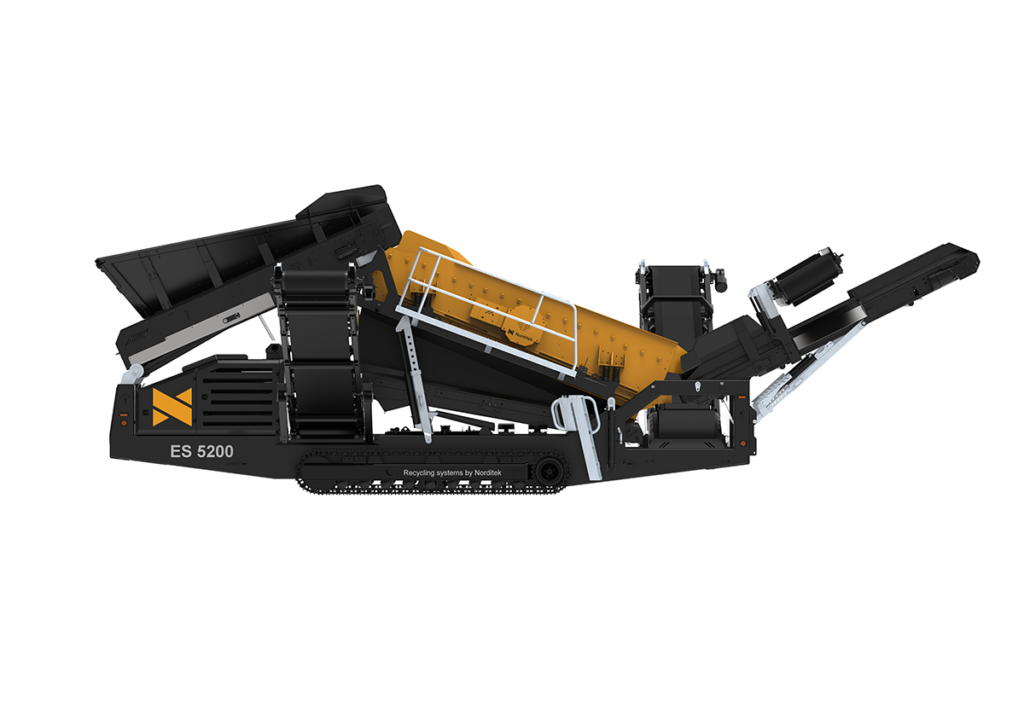
The Norditek ES5200 is an example of a modern Screening plants can be operated with either a flip-flow box or a rock box, depending on the application. The expanded screening surface produces cleaner fractions, and the smart sequence control can drive multiple modules from a single unit.

The sorting plant in the system

One of the biggest misconceptions is that the sorting plant is a standalone machine. In reality, it is a hub in our modular system. A crusher is often located upstream of the sorting plant to ensure the correct feed size. Downstream, a windshifter can windshifter light contaminants such as plastic and paper, a magnet can handle ferrous materials, and a water bath materials based on density.

The better these modules communicate with each other—mechanically, electrically, and in terms of material flow—the higher the overall recovery rate will be, and the cleaner the fractions you’ll end up with.

What should you consider when choosing Screening plants?

  • What type of material will be handled? (construction waste, excavated material, organic waste, etc.)
  • On average, how moist and sticky is the fraction?
  • What particle sizes do you need?
  • Should the machine be mobile or stationary?
  • Does it need to integrate with existing modules in your system?

The correct answers to these questions determine the choice of screen type, screen area, and drive system. A design tailored to your specific material flow makes a significant difference in terms of uptime, energy consumption, and maintenance costs.

Summary

A sorting plant is not just a machine—it is a strategic investment that determines how much value you can extract from your waste streams. With the right technology, the right size, and the right integration into your system, you can increase your recycling rate, lower your operating costs, and deliver cleaner materials to the market. Want to learn more about how our Screening plants your specific operations? Contact us at Norditek —we’ll help you find the right solution.

We are currently looking for an Export Manager

As Export Manager at Norditek, you will be responsible for building a dealer network in close collaboration with the CEO and the sales organization in particular. The goal is to establish a dealer network of nearly 20 dealers across Europe and the world.

As Export Manager, you will visit existing dealers—currently three in the Czech Republic, Benelux, and the Baltic states—as well as prospective dealers in selected countries.

We are looking for someone with experience as an export manager who understands the value of traveling to meet customers and do business. You have an understanding of and interest in technology, and are accustomed to navigating technical details and explaining the value of products and solutions. You are also accustomed to handling matters related to the financial aspects of the business.

Norditek is partnering with HERTIN / MANKERT to fill this position. Learn more about the position here

If you have any questions or concerns, please feel free to contact recruitment consultant Elin Mankert atelin@hertinmankert.se, and she’ll be happy to tell you more.

We are currently looking for a Purchasing Agent

As a buyer at Norditek, you will work closely with the aftermarket, product development, and marketing teams. You will primarily handle purchasing for the aftermarket, but will also support product development and handle some internal purchasing tasks.

We are looking for someone who thrives in a broader procurement role, preferably with experience from a smaller company in the manufacturing or machinery industry. You are self-motivated and enjoy being entrusted with significant responsibility and clear goals and metrics. This procurement role is new at Norditek, so you will have the opportunity to help shape both processes and working methods together with your colleagues across the organization. 

Norditek is partnering with HERTIN / MANKERT to fill this position. Learn more about the position here

If you have any questions or concerns, please feel free to contact recruitment consultant Elin Mankert atelin@hertinmankert.se, and she’ll be happy to tell you more.

The water bath: density separation for cleaner and more valuable recycled materials

Crushing and screening give you control over particle size. Magnets and windshifter metals and light contaminants. But what do you do with materials that are the same size but have completely different densities—such as concrete mixed with wood, for example? This is where the water bath is unmatched. By taking advantage of the fact that different materials float at different depths, the technology can separate fractions that are nearly impossible to separate using mechanical or air-based methods.

The Principle: Archimedes' Principle on an industrial scale

The water bath takes advantage of the fact that materials with different densities behave differently in water. Light materials—plastic, wood, and lighter organic materials—float on the surface. Heavy materials—concrete, stone, brick, and metal—sink to the bottom. Materials in the middle can be separated depending on the settings.

This seemingly simple principle enables separations with a level of purity that is difficult to achieve by other means. The result is fractions with a purity high enough to be sold as raw materials rather than classified as waste.

Application: construction waste

Construction waste is one of the most suitable materials for water treatment. Incoming construction waste typically contains a mixture of concrete, brick, wood, plastic, and metals. After crushing and screening, there is still a mixed fraction that is difficult to process mechanically. The water bath solves this problem: the wood floats to the surface, the concrete sinks, and the plastic fraction can be collected from the surface.

In a collaborative project with Ragn-Sells Häradsudden, Norditek demonstrated how adding a water bath the production line made it possible to sort more and cleaner fractions from construction waste—fractions that previously ended up in landfills.

Application: sand for road maintenance

When processing street sweepings, the input material often contains a mixture of sand, gravel, and organic matter. But it also includes inorganic materials such as plastic, snuff boxes, and all sorts of items discarded on our streets. Using a water bath , these water bath be separated efficiently, enabling the sand fraction to be reused for the next season. The same method is also used for similar applications instead of sending the material to a landfill.

Energy and the Environment

Water-based separation processes are relatively energy-efficient compared to thermal or chemical alternatives. The water can often be recirculated within the system, which minimizes consumption. From an environmental perspective, this technology helps keep more materials in the cycle and reduces the need for virgin raw materials.

Integration

The water bath is normally placed last or second to last in the production line—after the crusher, Screening plants and windshifter. Norditek’s modular concept allows the water bath to be integrated with other machines in the range without complicated modifications.

Summary

The water bath is one of the most effective methods for achieving the purity levels required by the materials market and regulatory standards. It is the technology that transforms mixed waste fractions into marketable raw materials. Would you like to learn more about how a water bath fit into your production line? Contact us at Norditek.

Modular recycling: how municipalities and recycling companies are building a future-proof production line

The recycling industry is changing rapidly. Regulatory requirements are becoming stricter, material markets are demanding higher levels of purity, and municipalities are expected to take on an increasing amount of responsibility for ensuring that materials are actually recycled—not just collected. In this context, flexibility and scalability are crucial. This is the essence of a modular approach: building a production line that can be adapted as conditions change, without having to tear everything down and start over.

What does "modular recycling" mean?

A modular recycling line consists of machines designed to work together—mechanically, electrically, and in terms of material flow. Each module performs a specific task: crushers reduce material size, Screening plants fractions, air screens remove light contaminants, magnets sort out metals, and water bath materials by density.

The key point is that these modules can be combined and replaced individually. If the material flow changes—for example, if a new fraction is added or capacity requirements increase—a new module can be added without having to rebuild the entire line.

Benefits for municipalities

For municipalities with limited investment budgets, the modular approach is particularly valuable. The investment can be made in stages: start with the most critical modules for the most common material flows and expand as needs and the budget allow. This reduces the initial capital risk and makes it easier to justify the investment internally.

The modular system also simplifies the procurement process: it allows you to specify functional requirements for each module, compare alternatives, and ensure that individual components meet the requirements without being locked into a single vendor’s system.

Benefits for recycling companies

For private operators, the key factors are flexibility and profitability. A recycling line that can be quickly reconfigured for a new material—or scaled up to increase capacity—provides a clear competitive advantage. Modular systems also make it possible to rent, lease, or purchase machines depending on the business model and the long-term reliability of the material supply.

Example: a complete line for construction waste

A typical scenario at a recycling facility that handles construction waste might look like this:

  • A jaw crusher or impact crusher reduces the feed material to a manageable size
  • Screening plants flip-flow technology separate fractions by size
  • windshifter plastic, paper, and light organic contaminants
  • Overhead magnet handles iron and steel
  • An eddy current magnet separates aluminum, copper, and brass
  • water bath the remaining mixed fraction by density

Each step in the process increases the purity of the final fractions and boosts their market value. The system can be started with just a few modules and expanded as needed.

Future-proofing

Perhaps the most important feature of a modular system is its ability to adapt to future requirements. The EU’s stricter regulations regarding packaging and construction waste, among other things, mean that material recycling requirements will increase in the coming years. A facility that is currently designed to meet these requirements—and that can be scaled up as they become even stricter—is a strategic asset.

Summary

A modular approach to recycling puts you back in control. You set the pace of your investment, you can adapt the system as conditions change, and you build a facility that will last for years to come. Norditek has been providing modular solutions to recycling facilities and municipalities for many years. Get in touch —we’ll help you plan a line that meets your needs today and tomorrow.

New position at the recycling lab!

As a test and development engineer, you will be at the center of this work and involved in ROI analyses and improvement projects from concept to testing and implementation, where you will play a key role in proposing business-oriented and resource-efficient solutions that leverage Norditek’s technology to create value. The work is carried out in close collaboration with colleagues and customers. For larger installations, you will also assist in a more project-management-oriented role. 

In this role, you will also be responsible for managing lab tests from start to finish, planning and conducting tests, analyzing results, documenting them in clear reports, and translating these insights into tangible value for both product development and sales. The work is varied, hands-on, and analytical—with a clear impact on technology and customer value. You will also help build and expand Norditek’s knowledge base regarding material properties, processes, and recycling, as well as ensure that sorting, sampling, and recycling are carried out in a structured and systematic manner.

Norditek House will serve as a hub for development and innovation in the recycling industry, where you, as a test and development engineer, will lead training sessions and facilitate knowledge sharing regarding our recycling systems.

Who We're Looking For

This role is ideal for someone who wants to combine technology, problem-solving, and the opportunity to make a real difference. You’ll have significant responsibility, quick decision-making processes, and the chance to help shape both our work methods and our offerings at a company dedicated to making recycling smarter, more efficient, and more systematic.

  • Technical education; a degree in mechanical engineering, mechatronics engineering, chemical engineering, or a related field is preferred
  • At least a couple of years of experience in technical project work
  • Experience working proactively in a customer-focused role
  • Experience working with needs assessments and reports
  • Technical generalist with an understanding of drawings, layouts, and CAD
  • Experience working in companies within an entrepreneurial environment

Travel may be required as part of the job, so a driver's license is required. Fluency in spoken and written Swedish and English is also required.

Application

Norditek is partnering with HERTIN / MANKERT to fill this position: https://hertinmankert.teamtailor.com/jobs/6961811-test-och-utvecklingsingenjor-till-norditek

First in the Nordic region with a new mobile washing solution for excavated material – order already secured

The mobile plant enables very rapid setup of a system for washing and recycling excavated material. The washing system is a fully container-based and modular system that can be set up quickly and offers high flexibility. The system consists oftwo 40-foot containers, the smallest configuration of any complete washing plant, making it particularly suitable for project-based recycling. 

The delivery also includesa water treatment system for recycling process water, which minimizes water consumption and enhances the overall effectiveness of the solution.

“We’re seeing a rapidly growing market for the recycling of excavated material. Demands are increasing, but so are the opportunities. With new technology, it’s possible to turn material that was previously considered waste into a resource, andthis washing system is a prime example of such technology,” says Daniel Carlberg, CEO of Norditek Group.

The modular solution is tailored to the customer’s project volumes and can be supplemented with sorting and air separation to create a complete process. The combination of mobility, a relatively low capital investment, and rapid commissioning makes this technology particularly attractive in today’s market.

This delivery is one of several similar washing solutions in a short period of time, confirming a clear increase in demand. According to Norditek, there is significant market potential in processing excavated material locally—in infrastructure, construction, and recycling—where large volumes are still sent to landfills or used for low-value applications.

“The fact that decisions are being made more quickly now shows that the market is maturing. More players are recognizing the business value of taking control of both their own and others’ data,” says Peter Macina, Business Area Manager at Norditek.

Norditek believes that the field of washing and processing excavated material will be one of the fastest-growing segments in materials recycling in the coming years.

Learn more about washing equipment for excavated material

Washing of excavated material – sustainable washing solutions for clean, recycled materials

We have methods for recycling excavated material directly on-site or converting it into marketable products at a facility, rather than simply sending it to a landfill. The main advantage of washing excavated material is that the method is relatively simple and allows for quick recycling when the material does not contain complex contaminants. However, most contaminants can be removed as long as the right method is chosen.

Laundry equipment that gets the job done

Norditek specializes in modular washing plants that are flexible and mobile, making them suitable even for smaller-scale operations. This makes it possible to recycle excavated material into sand and gravel even in projects that would otherwise lack the financial resources for a large, permanent facility.

Mobile laundry equipment has several advantages:

  • Capability to handle muddy and sticky materials:Our washing plants can process muddy and sticky materials and recover very fine fractions.
  • Particle sizes down to 0.1 mm:Norditek’s modular system makes it possible to produce particle sizes down to 0.1 mm. The result is clean, high-quality sand and gravel.
  • Scalable and modular:The systems can be expanded from simple recycling to more advanced sorting and are compatible with Norditek’s Screening plants air classifiers.
  • Lower investment:The mobile recycling plant requires a relatively small investment and offers greater flexibility because it can be adapted to the composition of the materials.

In addition to washing, Norditek also offers Screening plants, air separators, magnets, and belt conveyors that work in conjunction with the washing systems to create a complete recycling process.

The right method for the right materials

Excavated material may contain clay, silt, sand, gravel, stone, and various contaminants. Depending on the composition, both wet and dry methods are available to enable the reuse of the material in other projects. It is therefore important to begin with an analysis of the material’s composition in order to select the right combination of screening, crushing, washing, and separation. A thorough analysis reveals what can be recycled and what requires further processing.

Examples of materials suitable for washing:

  • Mixed soil with gravel, sand, or geotextile 
  • Contaminated soil (e.g., metals or chemicals) 
  • Loose soil with a high clay or moisture content 
  • Soil mixed with organic matter, stones, or metal 

When the right screening media are used for parameters such as moisture content, clay content, and roots, production can be optimized and recycling improved.

Examples of projects and development trends

Norditek, together with its partners, has developed a washing process that combines dry screening and washing. The process increases capacity and water efficiency while ensuring a high-quality end product. In the dry stage, large stones and clay are sorted out to increase capacity and reduce water consumption—the clay then does not need to be washed. Afterward, all iron is separated before washing begins. The washing process itself removes silt, clay, and contaminants such as textiles, wood, and plastic, leaving behind clean sand and stone completely free of impurities. The wash water is purified in a sedimentation basin and then returned to the process, allowing up to 90% of the water to be reused.

This process allows contaminated material to be reused in infrastructure projects instead of being sent to landfills. Ragn-Sells points out that washing and reusing soil reduces the burden on landfills and increases the supply of recycled aggregate. The goal is to meet cities’ climate targets, such as Gothenburg’s ambition to use at least 50% recycled aggregate by 2030.

Summary and Next Steps

Washing excavated material is the key to transforming problematic waste into a valuable resource. With modern washing solutions, modular facilities, and the right analysis, you can:

  • Extract clean fractions of sand, gravel, and stone from materials that would otherwise have been sent to a landfill.
  • Reduce the number of trips, save money, and achieve significant environmental benefits.
  • Scale capacity up or down depending on the size and needs of the project.
  • Help Sweden achieve its goals of increasing ballast recycling and reducing its carbon footprint.

Norditek offers flexible washing solutions that can be adapted to different types of soil and projects. Would you like to learn more about how to recycle excavated soil, contaminated soil, or production waste? Contact us for a customized solution.

Large-scale blending – the next step in sustainable pulp processing

A development is currently underway in Denmark that could transform the way we manage excavated material, sludge, and soil contamination throughout the Nordic region. Using Backer’s new mixing technology, companies have begun stabilizing roads, capping landfills, and reusing materials on-site—with a mixing precision of up to 1%.

The results have been so successful that the Danish government now sees hundreds of millions in potential savings, and the issue has reached the political level. The technology is environmentally friendly, resource-efficient, and circular—and ready to be introduced in Sweden.

Technology at a Glance

Backer’s mixing system enables continuous, precise, and reliable mixing of soil, sludge, and waste materials. Unlike traditional methods, the mixer can also handle unscreened and uneven material—without any downtime.

The system combines sorting and feeding into an integrated process that provides full control over the blending. The recipe—which may include lime, bentonite, biochar, or ash—is developed in collaboration with the customer based on the material’s properties and the desired outcome.

Applications

  • Soil stabilization and soil improvement– ensures that roads, noise barriers, and construction sites remain stable even in poor soil conditions.
  • Final capping of landfills– mix bentonite and soil to create impermeable, secure surface layers.
  • PFAS and other contaminants– stabilize and bind hazardous substances in the soil to prevent leaching.
  • Reuse of dredged material, clay, and excavated material– reduce transportation and the need for virgin material.
  • Rehabilitation of contaminated industrial sites—such as old sawmills—into developable land.

Why this is important for Sweden

Currently, there is a lack of large-scale solutions for precise and continuous mixing of materials. This technology opens up entirely new possibilities for:

  • reduce the amount of waste sent to landfills,
  • reuse local materials,
  • meet climate goals by reducing transportation,
  • reduce the costs of excavation and restoration work.

Germany already has legal requirements for local waste management, and Denmark is leading the way. Sweden now has the opportunity to follow suit—with Norditek and Backers at the forefront.

Next step

Starting next week, Our will be available. We are planning demonstrations and test runs where you can see exactly how mixing works in practice.

👉Want to learn more?

Contact Norditek to schedule a material analysis, demonstration, or site visit.

Hi Daniel Carlberg, how's it going?

We had a chat with Our , Daniel Carlberg.

 – What's happening right now?

There are new developments every day at our new headquarters, which is currently taking shape. This includes not only the buildings that ‘BRA bygg’ is constructing for us, but also the lab and testing environment that is coming together. There, we will soon be testing, developing, and building even better recycling processes together with our customers.

-Why is it so good?

This is one of Norditek’s biggest efficiency improvements to date. Previously, we could spend weeks testing materials that “might” be recyclable. But now we’re becoming so accurate with Our that a quick material analysis is often enough to determine whether a project is viable—or should be scrapped. We’ve simply become really good at saying no—or yes! With the new testing environment, we’re taking another step forward and can work with more materials, waste, and contaminants. We’re becoming even more accurate in both rapid analysis and full-scale testing.

-What else is coming up?

Next week we’ll be releasing Our , which will show how the year actually went—it’s going to be really exciting! In it, we’ll also share more about everything that’s in the works.

From Waste to Resource: How to Increase the Value of Wood Waste – Insights from Norditek’s Webinar

The starting point: understanding the material

Every wood waste stream is unique. To find the most cost-effective solution, you need to assess:

  • Type and volume of material– clean wood, contaminated reclaimed wood, bark, sawmill waste, or forest waste.
  • Contaminants– metal, glass, stone, or plastic that can cause equipment downtime or high ash levels.
  • End use– wood chips, pellets, landscaping soil, or raw material for new production.

Only when the goal is clear can the right technique be chosen.

The solution first—machines last

Norditek presents its"Norditektrappan" method: a process that always starts with the solution and the properties of the material before selecting equipment. This creates flexible and cost-effective systems for municipalities, recycling companies, sawmills, and forestry companies.

Three key takeaways from the webinar

1. Construction and demolition waste

The goal here is to produce a clean wood fraction for energy recovery.

  • Coarse crushingof the material.
  • Magnetic and eddy current separationremoves iron and aluminum.
  • windshifter water bathseparate stone, glass, and concrete.

The result is wood chips with a lower ash content, fewer production stoppages, and higher boiler efficiency—plus revenue from recycled metal.

2. Contaminated reclaimed wood

For heavily contaminated streams, the focus is on developing a fuel that reduces ash formation.

  • The right pretreatment can reduce bottom ash by up to50%and savemillions in boiler operating costs.
  • At the same time, the technology releases metals for recycling.

3. Forest waste, bark, and sawmill residues

The goal here is to produce biofuel with a high energy content.

  • Crushing and star screeningseparate soil and fine material from coarser material.
  • The double windshifterremoves any remaining gravel and stones.

Examples from the webinar show that sawmills have been able to reduce costs by60–70%by processing bark waste into a marketable biofuel fraction.

From Problem to Business

With the right technology, you can:

  • Save a lot of money by reducing downtime and ash handling.
  • Generate new revenue from metals and clean biofuels.
  • Reduce transportation and establish local material flows.

Practical next steps

Norditek will encourage participants to start with their own analysis:

Which material flows are the most pressing? What drives value—reduced landfill, fuel production, or on-site reuse?

Based on this, a modular solution can be built that combines a crusher, screen, magnet, and windshifter needed.


Register for: Webinar: Recycling Various Types of Wood Waste and Wood Materials – October 3

https://events.teams.microsoft.com/event/820946d8-cb49-46a2-bf83-7f0495537503@519d6e25-0e6d-4b79-986a-b92d97fa92ad

Wood Waste as a Resource: Creating Value Through Smart Sorting

Every year, construction and demolition projects generate enormous amountsof wood waste. It is often viewed simply as a cost to dispose of—but with propersorting,the material can instead be resold and generate revenue. This makes wood waste a valuable resource in the circular economy.

Different types of wood waste and their value

To successfullyrecycle wood waste, it is important to understand the different categories:

Solid wood (Grade A wood)

Untreated wood with high market value. Used aswood biofuel, pellets, or raw material for new building panels or furniture.

Painted or varnished wood (Class B wood)

Commonly found in demolition debris. After proper sorting, it can be used as fuel in heating plants. It can be separated from other clean wood through optical sorting.

Pressure-treated wood (Class C wood)

Contains chemicals and requires special handling. It has no direct economic value, but proper handling protects the environment.

Composite materials and furniture

Often contains wood, plastic, and metal. With modernsorting technology, these materials can be separated for recycling.

Economic benefits of wood recycling

Simply sending wood to a landfill is expensive. Byrecycling wood, companies can instead:

  • Reduce landfill costs.
  • Sell wood wasteas a raw material to heating plants, pellet manufacturers, or producers of building materials.
  • Increase profitabilityby supplying high-quality, clean materials.

With the right strategy, wood waste doesn’t have to be a burden—it can be a profitable business.

Sorting machines that increase the value of wood waste

The key to success lies in the technology. With Norditek’s wood sorting machines, companies can:

  • Separate Grade A lumber from Grade B and C lumber.
  • Remove plastic, metal, and other unwanted materials.
  • Deliver a product that meets market requirements.

In this way, wood waste is transformed into a resource that both reduces the environmental impact and strengthens the company’s business.

Conclusion: Wood waste as a resource in the circular economy

Recycling wood wasteisn’t just about the environment—it’s about the bottom line. Bysorting wood efficiently, companies can turn costs into revenue and contribute to a more sustainable future.

👉 Want to learn more about how Norditek’swood sorting machinescan help you maximize the value of your wood waste?Contact usat today.

It’s that easy to choose the wrong machine for your material flow

Yep, you heard right. Choosing the wrong machine is easy. A surefire way to choose the wrong machine is to simply start by looking for the machine you need. Choosing the right recycling machine isn’t about starting with the machine—it’s about understanding the material. Amaterial testgives you a clear picture of what you can get out of it, how clean it will be, and what it’s worth. That’s where you build your business.

Whether you’re dealing with excavated soil, demolition debris, industrial waste, biomass, or any other type of waste material, you should always start with a simple question:

What's in my material—and what can I do with it?


1. The material test demonstrates the potential of your flow

A material test provides answers to three crucial questions:

  • What can be separated?In which fractions are the contaminants found? Such as plastic, soil, stone, wood, or metal.
  • What technology can be used?Can pollutants be separated based on size, weight, density, aerodynamics, external characteristics (sensor technology)—or a combination of these factors?
  • How pure are the fractions?And how can they be used or resold?

The test provides you with a solid foundation for moving forward with a needs analysis, proposed solutions, and a cost estimate. With that information in hand, you’ll receive a proposed solution within two weeks—based on your actual materials.


2. The volume handled determines capacity requirements

Once you know what the material contains, the next step is to considerhow much of ityou handle and how often.

  • One-time flows or project-based?In that case, a mobile solution is often the best choice.
  • Large, continuous flows?In that case, stationary is more efficient over time, though it can still consist of mobile machines.
  • Need scalability?Modular solutions can provide the flexibility to grow.

We’ll help you scale the right solution for your volumes—and avoid over- or undercapacity.


3. The conditions on site determine which solution works

The sorting solution must work in practice, not just on paper. That’s why we’re looking at:

  • Space and accessibility:Is there electricity? How much space do you have?
  • Site conditions and logistics:Does the facility need to be moved frequently? Does it need to withstand winter weather?
  • Integration:Should sorting be combined with crushing or other further processing?

This affects both the choice of equipment and the installation solution.


4. The purpose of the material determines its value

What will the material be used for?

  • On-site reuse(e.g., base course, fill material)
  • Sales of products(e.g., combustible materials, metals, recycled soil)
  • Lower costs for hauling away or landfilling

Yourvalue isn’t created by the sorting process itself, but by what you can do with the sorted materials. That’s why we always start withthe end usein mind when developing a proposal.


5. Your Guide to Choosing the Right Machine – Step by Step

Here is Our for taking you from raw materials to recycled resources:

  1. Material testing– we analyze your material and propose a solution
  2. Volume and flow analysis– we select the right machine
  3. Site conditions– we adapt the design and mobility
  4. Business objectives– we tailor our approach to your needs: recycling, sales, reuse

Want to know what your materials are worth?

📦 We offermaterial testing with recommended solutions within two weeks.

🔍 You’ll find out exactly which waste streams can be sorted, how they can be used—and whether it’s worth the effort.

👉 Contact us to schedule a test. You have everything to gain—and plenty to recycle.

Report from the extraordinary general meeting in Norditek Group AB (publ)

The extraordinary general meeting adopted the following resolutions: 

  1. Amendment to the Articles of Incorporation: The meeting resolved, in accordance with the Board’s proposal, to amend the Articles of Incorporation, specifically with regard to the description of the company’s business. 

The new description of operations (§ 3 Operations) reads as follows: 

“The company shall develop, market, sell, and lease products, systems, and facilities for the engineering, construction, and recycling industries, and engage in asset management and related activities. These operations are conducted by the company or its subsidiaries.”

The amendment is intended to better reflect Norditek’s current and planned operations and to provide flexibility for future development. The decision will be filed for registration with the Swedish Companies Registration Office immediately. 

The decision was adopted by the required qualified majority (at least two-thirds of both the votes cast and the shares represented).

The voting quota was determined based on the number of registered shareholders and the proxies submitted. All formal requirements for holding the meeting were met.

No other resolutions were adopted at the meeting.

The information was provided by the contact person listed below for publication on July 28, 2025, at 11:30 a.m. CEST.

For further information about Norditek Group AB (publ), please contact:

Daniel Carlberg, CEO Norditek Group AB (publ)

Telephone: (+46) 702 19 04 91

E-mail: daniel.carlberg@norditek.se

Notice of extraordinary general meeting in Norditek Group AB (publ)

The shareholders of Norditek Group AB (publ), corporate registration number 559307-6986 (“the Company”), are hereby invited to attend an extraordinary general meeting on July 28, 2025, at 10:00 a.m. at the Company’s offices at Stora Åvägen 21 in Askim, Gothenburg.

Right to participate

The following persons are entitled to attend the meeting:

(i) is listed as a shareholder in the share register maintained by Euroclear Sweden AB as of the record date of July 18, 2025;

(ii) and have notified the Company of their intention to participate by July 22, 2025.

Registration must be submitted by email to info@norditek.se. Registration must be submitted by mail to Norditek Group AB (publ), Stora Åvägen 21, 436 34, Askim. The registration must include the full name, personal or corporate identification number, shareholding, address, email address, telephone number, and, where applicable, information regarding representatives, proxies, and assistants (no more than two).

Representative and Power of Attorney

If a shareholder is to be represented by a proxy, the proxy must bring the original written, dated, and signed power of attorney to the meeting. The power of attorney may not be more than one year old, unless a longer period of validity (not exceeding five years) is specified in the power of attorney. If the power of attorney is issued by a legal entity, the proxy must also bring a current certificate of registration or equivalent authorization document for the legal entity. To facilitate registration at the meeting, a copy of the power of attorney and other authorization documents should be attached to the notice of attendance. A power of attorney form is available below. The power of attorney form may also be requested by email as indicated above.

Fiduciary registered shares

To be entitled to participate in the meeting, a shareholder who has had their shares registered in the name of a nominee—such as a bank or other nominee—must, in addition to registering for the meeting, have the shares registered in their own name with Euroclear Sweden AB so that the shareholder is entered in the share register as of July 18, 2025. Such re-registration may be temporary (so-called voting rights registration) and must be requested from the nominee in accordance with the nominee’s procedures at least as far in advance as the nominee determines. Voting rights registrations made no later than July 22, 2025, will be taken into account when compiling the share register.

Proposed agenda

1. Opening of the Meeting

2. Election of a chairperson at the meeting

3. Preparation and approval of the voter list

4. Approval of the agenda

5. Election of one or two tellers to certify the minutes,

6. Determination of whether the meeting was properly convened

7. Resolution to amend the Articles of Association

8. The meeting is adjourned

Proposed Resolution

Item 2 – Election of a chairperson for the meeting

The Board of Directors proposes that Göran Nordlund be appointed Chairman of the Annual General Meeting.

Item 7 – Resolution to amend the Articles of Association

The Board of Directors proposes that the Annual General Meeting resolve to amend Article 3 of the Company’s Articles of Association as set forth below. The amendment is proposed in order to clarify and specify the Company’s business focus, including that the Company may conduct operational activities directly or through subsidiaries.

Current wording

§ 3 Activities

The company shall conduct business in the form of owning and managing movable property, mainly in the form of shares in subsidiaries, and conduct activities compatible therewith.

Proposed new wording

§ 3 Business Activities

The Company shall develop, market, sell, and lease products, systems, and facilities for the engineering, construction, and recycling industries, and engage in asset management and related activities. These activities are conducted by the Company or its subsidiaries.

For a resolution to be valid, it must be approved by shareholders representing at least two-thirds (2/3) of both the votes cast and the shares represented at the meeting.

Shareholders representing approximately 67 percent of the votes in Norditek AB have committed to voting in favor of the resolution.

Additional information

The full text of the proposed resolutions is included in the notice of the meeting. Proxy forms and other documents required under the Swedish Companies Act will be available on the Company’s website at least three weeks prior to the meeting. The documents will also be mailed to shareholders who request them and provide their address.

Information at the meeting

Shareholders are informed of their right to request information in accordance with Chapter 7, Section 32 of the Swedish Companies Act (2005:551) regarding matters that may affect the assessment of an item on the agenda.

Processing of Personal Data

For information on how your personal data is processed, see:

https://www.euroclear.com/dam/ESw/Legal/Integritetspolicy-bolagsstammor-svenska.pdf

___________________

Gothenburg in June 2025

Norditek Group AB (publ)

Board of Directors

For further information, please contact

Daniel Carlberg, President and CEO

daniel.carlberg@norditek.se

15 Förrådsvägen, 918 31 Sävar

www.norditek.se

The shares of Norditek Group AB are traded on the Nasdaq First North Growth Market.

The Certified Adviser is Partner Fondkommission AB, with the email address info@partnerfk.se and the phone number +46 31 761 22 30.

About Norditek

Norditek Group AB is listed on Nasdaq First North and specializes in technical solutions for the recycling of excavated material, construction and demolition waste, biomass, and other residual materials from industrial production. The Group develops, sells, and leases mobile and stationary plants that efficiently separate and process large volumes of mixed materials. Through a combination of technical expertise, systems thinking, and customer-focused development, Norditek enables increased resource recovery with reduced environmental impact.

We are looking for an experienced Service Technician

Would you like to work with a forward-thinking team to ensure high-quality service and optimal availability of our machine fleet? By delivering a high level of service, you’ll help ensure that Norditek’s customers experience the high standards of our machines and that they retain their value over time. The work takes place in Our workshop but also involves supporting customers’ operations with fast and knowledgeable on-site support. 

Apply for the position here:

Would you like to work as a Financial Assistant 2.0!?

Job Description

Norditek is seeking a humble and dedicated financial assistant who is interested in working in a diverse role involving finance, administration, and coordination. The role involves working closely with the Finance Manager, as well as collaborating with the Marketing Manager, the sales team, and external partners.

Your main focus in economics will be: 

  • Day-to-day bookkeeping
  • Incoming invoices
  • Expense Report – Receipts, Mileage Reimbursement 
  • Balance sheet reconciliations
  • Manage certain aspects of VAT
  • Report employer contributions, estimated tax to the Swedish Tax Agency, etc.
  • Payroll administration

In terms of administrative and coordination tasks, you will primarily be responsible for: 

  • Provide support at trade shows and customer events through coordination and planning 
  • Manage customer lists and mailings 
  • Support the sales organization with administrative tasks to ensure a well-organized structure

Norditek is committed to creating a very pleasant work and office environment, and every role in the company shares responsibility for this. Your role includes purchasing office supplies and snacks for the office. 

You will report to Finance Manager Fredric Johansson. The position is based at the Gothenburg office while the Norditek Recycling Lab in Fjärås is being completed. 

What we're looking for

We are looking for someone with an interest in and a basic understanding of finance who thrives in a role with varied responsibilities where no two days are alike. You have solid experience in prioritizing tasks and taking the initiative to do what needs to be done in the best interests of the company and its customers. 

We are looking for someone with: 

  • At least 4–5 years of professional experience in a role involving similar responsibilities, including both finance and administration
  • Experience working with Fortnox 
  • Good computer skills
  • Speaks and writes Swedish fluently and has a basic knowledge of English

To thrive and succeed in the role of Financial Assistant at Norditek, you need experience working at small, growing companies with flat hierarchies and a strong emphasis on collaboration among colleagues. 

Application

For this recruitment, Norditek is collaborating with HERTIN / MANKERT. 

Please submit your application as soon as possible, as we are reviewing applications on an ongoing basis. If you have any questions about the position, please feel free to contact recruitment consultant Elin Mankert atelin@hertinmankert.se

We look forward to receiving your application!

Would you like to work as a Sales Engineer and manage recycling projects?

About the position:

As a sales engineer at Norditek, you will work closely with the sales team to develop technical solutions and manage projects, from concept through testing to implementation. The role involves visiting customer sites to understand their needs. You will also work on testing, material analysis, and the development of advanced systems at Norditek’s new office, “Norditek House,” in Fjärås.

Job Responsibilities

  • Technical Sales and Project Support: Workclosely with the sales team to develop technical proposals for more advanced recycling systems. You will also be responsible for technical layouts, drawings, and CAD. 
  • Client Visits:Identify and analyze client needs in collaboration with the sales team, from ROI analyses to delivery. 
  • Project Management:Oversee projects from concept to completion, with a focus on business-oriented and cost-effective solutions. 
  • Norditek House:As part of the sales process, you will conduct tests to scientifically establish the basis for layouts and develop more advanced recycling systems. You will also perform technical material analyses and build a knowledge base on material properties.
  • Methods and processes:Develop and document work methods for sorting, sampling, and recycling, and identify opportunities for improvement and solutions in existing and new process flows.
  • Training:Conduct training sessions on advanced recycling systems for customers, both in person and via webinars. 

What we're looking for

We are looking for someone with a bachelor’s or master’s degree in mechanical engineering, industrial engineering, environmental engineering, chemistry, or a related field, and with experience working closely with production, machinery, or processes. You are highly self-motivated and eager to develop your knowledge and understanding of Norditek’s product portfolio, systems, and customers, and you share Norditek’s commitment to recycling, sustainability, and technology. 

As a person, you are dynamic and interested in customer needs, which means you stay attuned to market trends and tailor your solutions accordingly. We see that you are both analytical and methodical, with strong execution skills and experience in managing projects. Furthermore, you are a strong communicator and ensure that every customer meeting lays the groundwork for long-term business relationships. 

You thrive in an entrepreneurial environment where collaboration is key to success. 

Application

For this recruitment, Norditek is collaborating with HERTIN / MANKERT.

Please submit your application as soon as possible, as we are reviewing applications on an ongoing basis. If you have any questions about the position, please feel free to contact recruitment consultant Elin Mankert at elin@hertinmankert.se

We look forward to receiving your application!

Elmia Wood, June 5–7: Wood Recycling – How to Create Clean Fractions

Wood recycling – from waste to raw material

Wood recycling is a key component of the circular economy—but it requires smart solutions to succeed. At Norditek, we developmobile sorting solutionsthat make it possible to manage wood waste in an efficient, profitable, and sustainable way.

What is the challenge of wood recycling?

Wood waste often contains contaminants such as:

  • Plastic
  • Stone and sand
  • Iron, aluminum, and precious metals
  • Moisture and dirt

In order to recycle wood as a material or use it as fuel in bioenergy plants, these materials must be sorted out—with high precision.

Our solutions

At Elmia Wood, June 5–7, we’ll be demonstrating how our machines:

Separate plastic, metal, and stone—both large pieces and small fragments

Removes moisture and sandto increase the calorific value

Sorts different types of woodto produce clean fractions

Uses optical technologyto identify and remove unwanted materials—including small pieces of plastic and metal

The result?

🔹 Clean wood materials ready for new products

🔹 Optimized fuel fractions with even combustion

🔹 Higher recycling rates and reduced emissions

Come see us at Elmia Wood

📅 Date: June 5–7

📍 Location: Elmia Wood, Jönköping

🔧 Part number: WC9132

Stop by and experience the difference with our mobile recycling solutions. We’ll show you how technology and a systematic approach can transform wood waste from a source of pollution into a valuable resource.

Contact us today to schedule a meeting!

Do you handle materials that are difficult to sort?

Do you have non-magnetic metals or plastic contaminants that need to be separated from your waste streams? Join us at Norditek’s Demo Days—an opportunity to see our solutions for complex waste management in action.

Contact us to schedule an appointment

Bring a material sample, and we’ll analyze it on-site and show you how our modular machines—such as eddy current separators, air classifiers water bath and water bath can optimize your recycling process.

By testing our solutions with your own materials, you’ll gain a concrete understanding of how we can help you improve your waste management.

Learn more about our machines for difficult materials

By combining our modules, Norditek can tailor solutions for various types of waste streams. For example, a process might begin with a Screening plants a windshifter remove light contaminants, followed by an eddy current magnet to extract non-magnetic metals, water bath then a water bath separate materials based on density.

See and read more about our modules here:

🔄 Eddy Current Separator

Function:Uses rotating magnets to induce currents in non-magnetic metals (such as aluminum and copper), creating a magnetic field that repels these metals from other materials.

Applications:

  • Separation of non-magnetic metals from mixed construction and demolition waste.
  • Recycling of metals from wood waste and other bulk materials. 

Advantages:

  • Efficient recovery of valuable metals that are otherwise difficult to separate.
  • Reduces the need for manual sorting and improves the purity of recycled materials. 

🌬️ windshifter

Function:Uses controlled airflows to separate materials based on weight and density. Lighter materials are blown away from heavier fractions.

Applications:

  • Removal of plastic, paper, and other light contaminants from soil and compost.
  • Separation of plastic from wood in construction waste. 

Advantages:

  • Improves the quality of recycled soil and compost.
  • Enables the production of cleaner fuel fractions from mixed waste. 

💧 water bath float-sink separation)

Function:Takes advantage of differences in density between materials. Materials that are lighter than water float, while heavier materials sink.

Applications:

  • Separation of plastic from stone, glass, and metals in mixed waste.
  • Removal of contaminants from soil and excavated material. 

Advantages:

  • High separation efficiency for materials of similar size but different density.
  • Reduces the amount of contaminants in recycled materials. 

Upcoming webinars!

Webinar: Effective Recycling of Waste Materials.

🔍 An in-depth look at contaminated soil

💧 Washing of excavated material

🚜 Mobile, semi-stationary, and stationary—which is best for which situation?

📅 Don't miss out! Sign up now. For more information, click the links.

👉 May 23: https://events.teams.microsoft.com/event/496b0275-8402-41e5-a41f-43e7c5923e96@519d6e25-0e6d-4b79-986a-b92d97fa92ad

👉 June 26: https://events.teams.microsoft.com/event/f8730c1d-d133-49ed-8b07-cc897531f57c@519d6e25-0e6d-4b79-986a-b92d97fa92ad

Webinar:Recycling of Wood Waste

This webinar has been rescheduled! Here, we’ll go over various methods for processing and recycling wood materials—from recycling reclaimed wood and forest waste to pre-treating biofuels. We’ll also take a closer look at solutions involving optical sorting.

📅 Don't miss out! Sign up now.

👉 October 3: https://events.teams.microsoft.com/event/820946d8-cb49-46a2-bf83-7f0495537503@519d6e25-0e6d-4b79-986a-b92d97fa92ad

MOVED: Webinar on wood waste recycling on October 3

In this webinar, we’ll explore various methods for processing and recycling wood materials—from recycling reclaimed wood and forest waste to pre-treating biofuels. We’ll also take a closer look at optical sorting solutions. Above all, we’ll show you what the process looks like when building effective solutions!

Link to the webinar: https://events.teams.microsoft.com/event/820946d8-cb49-46a2-bf83-7f0495537503@519d6e25-0e6d-4b79-986a-b92d97fa92ad

Here’s what we’ll cover in the webinar:

Methods for recycling various wood materials:

    •Forest waste:Bark, stumps, and forest residues

Effective separation of contaminants such as stones, plastic, and sand

Production of high-quality biofuels

    •Return wood:

Separation of plastics and various metals (including precious metals)

Sorting of various wood materials for new products 

    •Fuel pretreatment:

Separation solutions for removing plastic, metal, and moisture

Fractions that optimize efficiency in combustion plants

The process

  1. Material and requirements analysis: Material testingin a laboratory setting, assessment of the production environment, capacity calculations, etc.
  2. Proposed Solution: Planningequipment and processes to maximize recycling value
  3. Full-scale testing: Test runs, adjustments, and a results report to inform decision-making.
  4. Reduced investment risk: Scalingthe project’s scope through a phased approach and a rent-to-own model

Learn more about our solutions for recycling wood waste.

Recycling of byproducts from biogas production – from waste to product

Many biogas production facilities generate a residual material—a contaminated by-product filled with plastic, organic matter, and other contaminants. This material is often viewed as hazardous waste destined for landfills or incineration. At Norditek, we see something different: the opportunity to separate, process, and recycle.

In this video, we show how contaminated waste can be transformed into clean fractions that provide both economic and environmental benefits.

What is biogas production waste?

Digestate is what remains after organic material has been converted into biogas. It often contains plastic debris, soil, and other contaminants that make it difficult to recycle.

The challenge – and why it matters:

Managing rejects in a sustainable and profitable way has several advantages:

• Reduced landfill costs

• Reduced environmental impact

• Increased resource efficiency

• Ability to collect plastic and organic materials for recycling and energy recovery

Our :

Through test runs, material analysis, and the use of flexible machine systems, we can:

• Separate plastic from organic waste and soil

• Create clean fractions for recycling

• Optimize processes to suit each individual material flow

A concrete example:

In a recent test run, we processed a byproduct from biogas production with a high level of contamination. The result:

• Clean soil fraction

• Plastic removal

• Significantly reduced waste sent to incineration

The potential for additional material streams:

We know that many material streams in Sweden and the Nordic region hold untapped potential. Whether it’s biogas residues, excavated material, bioash, or other difficult-to-process materials—with the right pretreatment, much more can be recovered.

Would you like to know what you can do with your material?

We offer material testing services in which we analyze and calculate the potential for recycling and processing. Contact us and send us a photo or a material sample—we’ll determine what’s possible.

Norditek Recycling Lab is becoming a reality – in collaboration with BRA Bygg

Norditek has signed an agreement with BRA Bygg for the construction of the Norditek Recycling Lab—a project that, once completed, will represent a major step forward in the development of new solutions for recycling and circular flows. Construction will begin in the first quarter of 2025 and will have a strong circular focus.

– To practice what we preach, both the construction process and project execution will place an equally strong emphasis on circularity. Together with BRA Bygg, we will use recycled materials throughout the entire project—from groundwork to the finished buildings. This involves recycled fill, recycled steel, reused brick, and wood. Fill management is particularly interesting because it has often been an overlooked part of construction projects, even though we see that this specific aspect can provide the greatest climate benefits, says Daniel Carlberg, CEO of Norditek.

Early concept image of the Norditek Recycling Lab. Photo: Design Architecture Firm

A center for testing, training, and innovation

The Norditek Recycling Lab will consist of three integrated buildings housing testing labs, training facilities, offices, and machine demonstration areas. The buildings have a total floor area of 1,350 square meters and a volume of 6,000 cubic meters.

“For us at BRA Bygg, this is an exciting project for two reasons. First, we’re gaining a deeper understanding of the processes involved in circular material management, and second, we’re getting the opportunity to put circular construction into practice,” says Magnus Andersson of BRA Bygg.

Norditek has long been working to facilitate the recycling of excavated material, industrial waste, and other material streams. With the Norditek Recycling Lab, the company is taking the next step by focusing on developing the recycling process itself—with the goal of enabling more recycling projects than ever before.

“This is a project where we at Norditek really get to show what we stand for. We don’t just create smart recycling solutions—we ensure that materials are actually given a new lease on life in new projects. With the Norditek Recycling Lab, we also gain a space where we can test, educate, and demonstrate the recycling of the future,” says Daniel Carlberg.

The Norditek Recycling Lab is being built in Duvehed, Kungsbacka Municipality.

The biggest mistakes in excavated material recycling—and how to avoid them

Excavated material can be a resource or a problem—it all depends on how it’s managed. Unfortunately, we often see people falling into pitfalls that make the process more expensive, inefficient, and less sustainable. Here are the three biggest mistakes—and what you can do instead.

❌ 1. Relying on landfills as the default solution

The problem:Transporting excavated material to a landfill may seem like a quick fix—but it’s expensive and often unnecessary. Furthermore, regulations are constantly becoming stricter, making the landfill option less reliable in the long run.

The solution:Treat excavated material as a raw material. By using the right technology, you can wash, sort, and recycle the material for use in new projects.

❌ 2. Failing to analyze the material before making a decision

The problem:Many people dispose of excavated material without knowing what it actually contains. This can lead to unnecessary costs or, in the worst case, legal problems if the material contains contaminants.

The solution:Conduct a material analysis early on. With a simple test, you can determine which fractions can be recycled directly on-site.

❌ 3. Mixing everything together in one pile

The problem:Many people think that excavated material is “just soil,” but it often contains plastic, metal, wood, and other waste. The more mixed the material is, the harder (and more expensive) it becomes to recycle.

The solution:Sort at the source! By sorting waste properly right at the workplace, you can reduce both transportation costs and landfill fees.

Would you like to learn more about smarter management of excavated material? Get in touch, and we’ll explain how we can help you increase recycling and reduce costs.

Contact us

What can we help you with?

Feel free to contact us and we will tell you more about how you can maximize your recycling.