Our We see increased investment in Aftermarket as a crucial part of the development towards a stronger overall concept for our customers. Therefore, we are now looking for you who are driven and business-oriented for the position of Business Area Manager Aftermarket.
As Business Area Manager Aftermarket, you will play an important role in further developing the Aftermarket product range, a business area with great potential.
You will be responsible for developing the product range with products that optimize and improve customers' machinery. The range consists of wear and spare parts and you are responsible for ensuring that we have the right products in stock at the right purchase price and at the right customer price.
You manage and run the business area together with your team of four, through our service partners around the country and in close cooperation with customers and suppliers. Together you are responsible for developing Our aftermarket into the best in the industry. To succeed, you need to work proactively to deliver the complete solutions that customers demand.
This is a new role at Norditek and you will be involved in shaping it.
The article is based on an interview with President and CEO Daniel Carlberg about the journey from 2013 to last fall's IPO and the keys to getting to where they are today.
Costly production stoppages in municipal heating plants are a common problem across the country. Right now, a municipality in central Sweden is the first to try the technical solution that addresses the problem caused by aluminum packaging in the waste.
When the aluminum, which arrives at the cogeneration plant via the garbage truck, is fired in the boiler, it melts and flows into the air holes where it solidifies. This means that the entire boiler has to be shut down and the metal knocked out by hand. Such a shutdown can happen several times in a year and cost millions each time. With Our 's technical solution to separate aluminum from, for example, recycled wood, it is now possible to both avoid production stops and to recycle more of the energy-intensive metal.
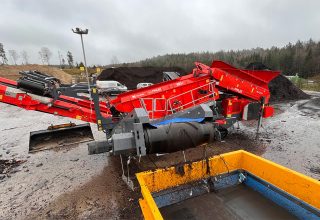
The picture shows a plant that separates metals from waste wood.
By adding a powerful eddy current magnet and adapting Norditek's flexible plant to the material flow, all incoming material can be separated and recycled more efficiently. The technology enables metal recycling of small particles of non-magnetic metal (such as aluminum).
Great benefit at the community level
There are over 300 heating plants in Sweden today, many of which have the same problems, which means that the social cost of the loss of production is hundreds of millions. It also means that the amount of aluminum that can be recycled has a significant impact on the recycling rate of aluminum in Sweden. This recycling saves 95% of the energy otherwise needed to create new aluminum.
It's not just about aluminum
The problem also arises with waste coming from the construction side, where there may be brass and other metals that present the same challenge to manage.
The advantage of Norditek's flexbila plant is that it is easily adapted to new material flows. If the next batch of waste coming in contains a different metal, plastic or material size, the modular plant can easily be adapted, expanded and optimized for the new flow.
More benefits of the technology
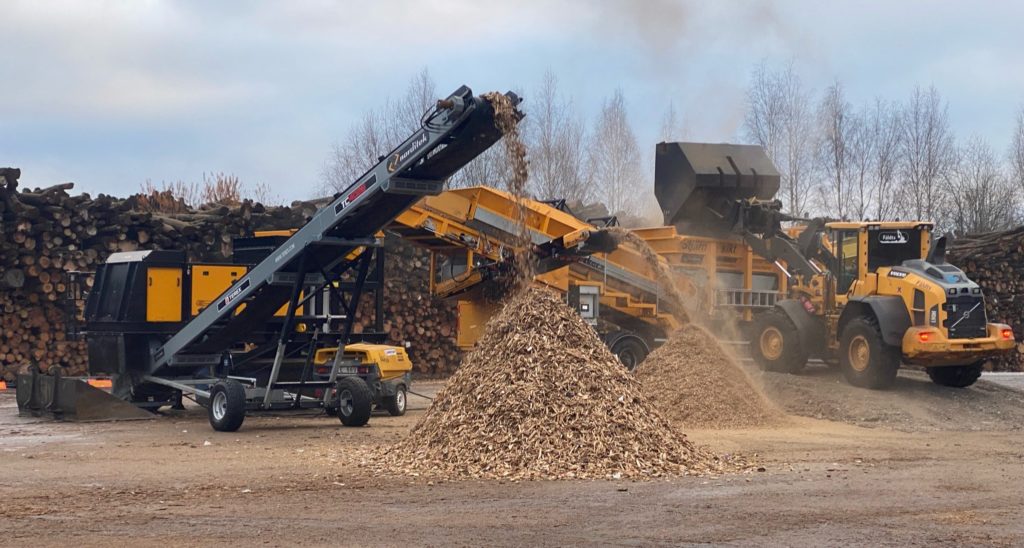
With the help of Screening plants, wind sifters and water bath , Norditek's facilities make it possible to achieve a very far-reaching and efficient recycling of different types of waste.
The advantage is not only an increased recycling rate, but also reduced transportation and reduced mining operations. Last but not least, it also gives the material owner increased revenues with higher revenues on all end products.
The film shows a plant that separates metals from waste wood.
Terex Washing Systems are flexible plant solutions of washing equipment for excavated material and recycling of aggregates. Norditek looks back on a successful collaboration with the Terex group and is pleased to be able to expand the product catalog on the Swedish market with the leading products for establishing smaller production facilities in washing and recycling.
Terex Washing Systems' plants are both flexible and more mobile, which means that they work very well even for smaller production. It is possible to recycle excavated material even for more people because the investment is smaller, mainly because the plant is optimized compared to a larger plant.
Possibility of obtaining very small fractions
The plants can deal with muddy and sticky masses and obtain very small fractions. It is possible to obtain fractions down to 2-4 mm. When dry washing is not enough, a plant from Terex Washing Systems is a good investment.
Our Experience shows that there are major economic and environmental benefits to be gained from increased recycling of excavated material.
Since the handling and excavation of new excavation materials often leads to an unnecessarily high climate impact, the Swedish Public Procurement Agency has recently developed new sustainability criteria for excavation materials that can be used in procurement and project planning.
Hi Niklas! What is most fun about working at Norditek?
- The best part is that we don't just sell machines off the shelf. We solve the customer's problem. Often we can do it in a different way than what the customer asks for and help them with a solution that they don't see themselves, because they don't know that there are lots of different ways to work with the material. It's great to see many different problems that companies have and to be able to help them recycle more material.
So what are customers asking for?
- For example, a customer may call in and say they want a particular machine. But instead of saying yes, it costs so and so, we say: - sure, what kind of material do you want to run? Since the materials often look different, we would like to see the material, we can do a test run and demo for the customer, adapt the plant and make sure it is good.
What else do you do at Norditek?
- I'm responsible for Norditek's facility in Fjärås, where all the machines going out to the field in southern Sweden land first. I make sure the machines are ready to do the job. Since we do a lot of different jobs, a lot of adaptation is often required. For example, the machines have to go out and sort construction waste and plastic, recycle excavated material, or crush stone. The jobs and problems look different, so it's not always right the first time and if it's not good, we may need to insert a new component. We go out and test or make a start-up, adjust, lab with parameters, adapt a machine or the whole concept.
What else do you do in services?
- We work with service all around Sweden as it is Our market. The country is far and we have offices in Umeå and Gothenburg with close cooperation between us and our service partners. In the service part, I also work with the development of local production, delivering spare parts, managing our telematics system with connected machines and more. But above all, solving customers' problems in the field. This makes it a very versatile job with a lot of problem solving.
Now that Norditek is recruiting, who do you think the job is for?
- Someone technically interested, who thinks the recycling industry is an interesting place to be. We talk a lot about solving problems and there are short decision paths and easy to get help from colleagues in a smaller organization so it's not cumbersome. If you like to sit at the computer and talk to customers and solve problems, it's perfect. And if you like to develop the way we work, that opportunity is also available. We are growing and we have the will to invest a lot in development. We are a small company where a lot happens!
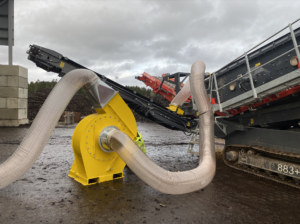
There are many different types of plastic and sometimes it is a difficult task to remove them all. Air suction is a multi-purpose technology that can be a great option for getting clean fractions of materials, both organic and inorganic. We are currently testing it to see what it does best and we have the opportunity to try it on many materials. If you have any material you want to test drive, you are always welcome to contact us.
For example, separating plastic from unsorted construction waste can, alongside other technologies, produce a fossil-free fuel made from wood. By blowing plastic out of compost waste, the soil can be reused for soil production and planting instead of being piled up in a landfill. The process also makes it possible to separate wood and sticks separately, resulting in a pure biofuel.
By adding air suction, cleaner fractions can be recovered.
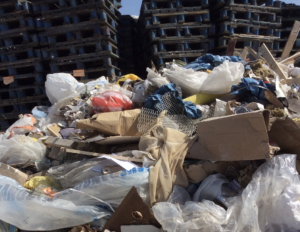
New technology to deal with unsorted construction waste containing plastic
There are currently many different flows that contain unwanted plastic where we can now remove the plastic to obtain clean fractions. The material can then be recycled or contribute to increased energy recovery. It's all about getting clean fractions and materials that can then be recycled.
We are excited to see what else we can do with this technology and look forward to testing it on your materials.
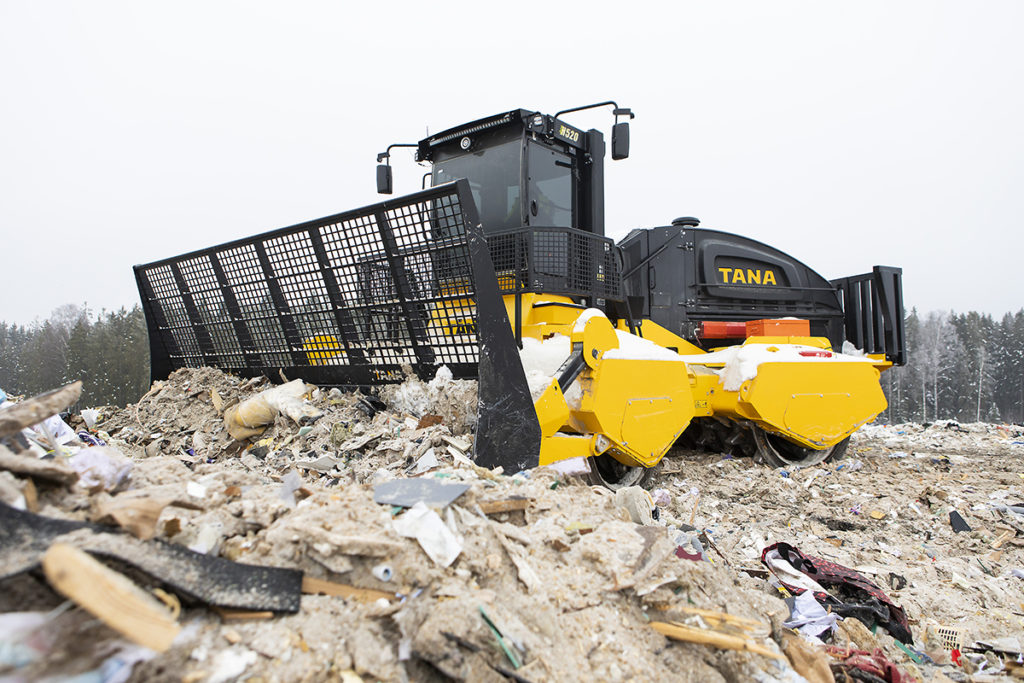
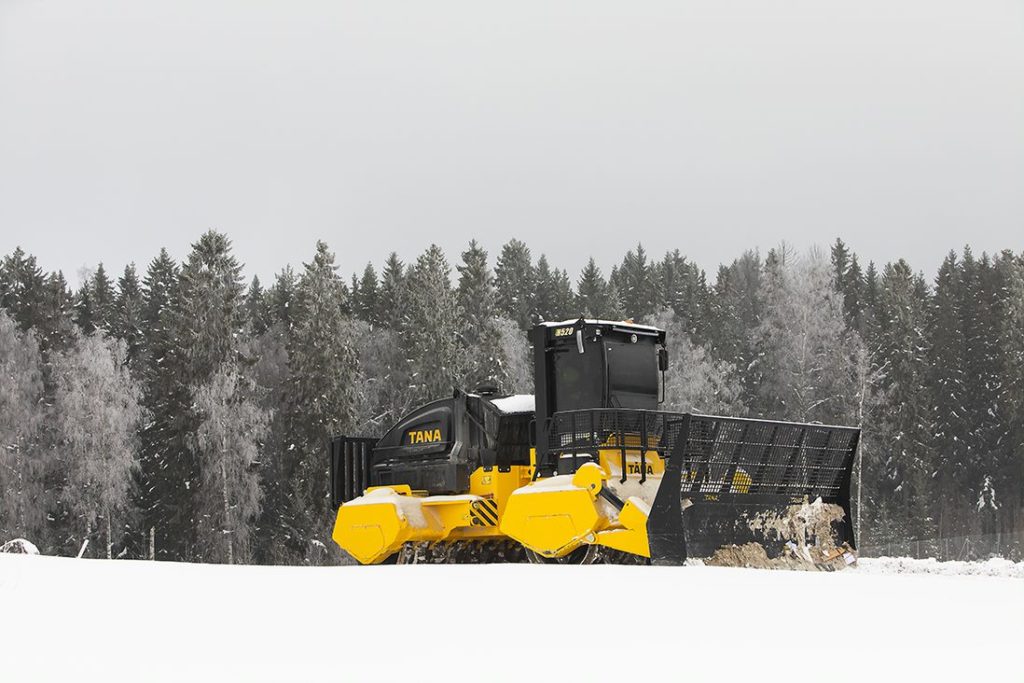
TANA's unique full-width drum compactors, rigid frame and large crusher teeth ensure optimal compaction results. The new H-Series models manage waste cost-effectively, offering maximum compaction and disposal capacity with low operating costs.
The new H-series includes models in the range of 38-52 tons: H380 and H380eco, H450 and H450eco, and H520 and H520eco. The H-series models have several new and improved features that make them even more efficient and reliable; for example, their speed has been increased to 10 km/h (6.2 mph).
We have listened to TANA users and paid particular attention to operator comfort. H-series compactors have a spacious cab with excellent visibility in all directions, including rear view cameras. A comfortable driver's seat and ergonomic controls ensure excellent working comfort. The TANA Control System (TCS) features a new user interface that further improves driveability and machine operation. The menu is clear and easy to use, and it quickly displays dials for speed, rpm and engine load. The user interface features a graphic touch screen and offers the operator extensive adjustment and diagnostic options.
All TANA landfill compactors are equipped with TANA ProTrack®. An information management system that connects the machine to a computer network. This easy-to-use tool facilitates maintenance and provides real-time information on machine performance and status. The TANA ProTrack® information management system can be used on a tablet, smartphone or computer.
The handling and excavation of new excavated soil leads to an unnecessarily large climate impact. The procurement authority has therefore developed new sustainability criteria for excavation materials that can be used in procurement and project planning.
Sustainability criteria for excavated soil - good in many ways
– “Our ’s experience is that there are significant economic and environmental benefits to be gained from increased recycling of excavated material. We therefore welcome these new sustainability criteria for excavated material and are ready to provide the technical solutions needed to help those who will be handling the material in accordance with the new requirements,” says Daniel Carlberg, CEO of Norditek Group.
According to the procurement authority, the climate impact of the construction sector must be significantly reduced and contracting organizations can make a difference by setting higher sustainability requirements when making purchases. Therefore, criteria have been developed for the handling of rock, sand, gravel and other excavation materials. The requirements should help to increase the reuse of masses and reduce the associated transports. Norditek has extensive experience in recycling excavation masses and topsoil and we are ready to deliver the technical solutions that meet the new requirements.
For example, see how our Terex Washing Systems machines recycle excavated soil in Belgium.
To provide a good experience, we use technologies such as cookies to store and/or access device information. When you consent to these technologies, we may process data such as browsing behavior or unique IDs on this website. If you do not consent or if you withdraw your consent, this may adversely affect certain features.
Functional
Always active
The technical storage or access is strictly necessary for the legitimate purpose of enabling the use of a specific service explicitly requested by the subscriber or user, or for the sole purpose of carrying out the transmission of a communication over an electronic communications network.
Alternative
The technical storage or access is necessary for the legitimate purpose of storing settings that are not requested by the subscriber or user.
Statistics
The technical storage or access used exclusively for statistical purposes.The technical storage or access used exclusively for anonymous statistical purposes. Absent a lawsuit, voluntary compliance by your ISP, or additional records from a third party, information stored or accessed solely for this purpose usually cannot be used to identify you.
Marketing
The technical storage or access is required to create user profiles to send advertising, or to track the user on a website or across multiple websites for similar marketing purposes.