
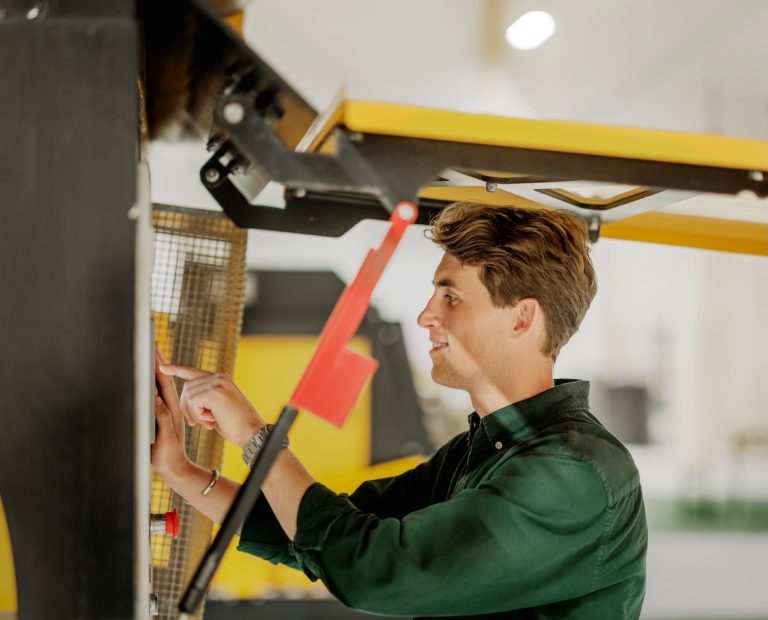
Albin Lindgren joined Norditek two years ago as a project manager for product development. Today, he is the regional sales manager for Svealand and Norrland. We asked him to tell us what surprised him and why he enjoys his job. His answer revolves around curious colleagues, a great deal of autonomy, and a job that makes a difference.
We met Albin at Norditek on his second birthday. Happy birthday! How are you celebrating?
We celebrated with cookies, coffee, and a serious sugar rush. A year ago, I bought soap bubbles instead, since I’m more of a potato chip and carrot stick person. Nobody was particularly interested in them. Not this year either. So I went with sugar. Everyone likes that.
What was it like to work as a product developer at Norditek?
For a year and a half, I was the project manager for product development. Since May, I’ve been working in sales. As a product developer, I started by assembling a team of consultants. I defined what we wanted to do, and everyone had to sign a non-disclosure agreement. Each person had specialized expertise. I coordinated everything so that what we simulated could actually be built—so that someone skilled in electrical engineering could design it and someone else could handle the CE marking. That way, we were able to move forward quickly on short-term projects at a low cost, without having to build an entire organization from scratch.
How does product development work at Norditek?
Very close to the customer. Norditek’s philosophy is that most problems can already be solved using existing technology. Improvement projects often focus on operational reliability, better separation, higher purity, or greater capacity.
Sometimes five customers have asked for the same thing, and in those cases, one of them may be ready to develop it with us in a pilot project. In that case, the customer sets clear specifications. For example, we tested a material where small dust particles got stuck in the machine. Using CFD simulation, we could see that we were getting backflow at certain settings. This led to a design change so that all flow goes in the right direction, and now it’s standard on all new machines. It’s also available as an add-on for older models.
Which project has taught you the most?
A project in which a customer wanted to know how much material passes through their process. We tested a belt scale. It works well for uniform flows like crushed rock, but not when the material consists of alternating layers of wood, insulation, concrete, and glass. We then measured the current in the conveyor’s electric motor. It turned out that the outdoor temperature affected the measurement more than the material itself, since rubber becomes stiffer in cold weather.
The project lives on, but now with cameras and AI. It’s really the same project that has evolved as we’ve recognized the limitations of each technology. That’s exactly how we want to work. We don’t want to come up with solutions on our own; instead, we want to work closely with the client and arrive at solutions together.
Since May, you’ve taken on a new role as regional sales manager. How has your experience as a product developer helped you?
The barrier to solving the customer’s problem is lower. I’ve made so many modifications to machines that I can confidently help customers when they need a customization or want to connect machines. I can also point out components in the electrical cabinet, explain why they look the way they do, and educate customers on the capabilities of various components as well as the available options.
What surprised you when you were new and started at Norditek?
No one tells you what to do. It’s more like: within this framework, if something happens, how would you like to handle it? Today, I’m very self-reliant, and I wouldn’t have been if I’d been micromanaged from the start.
Once you ask a question, you get everyone’s full attention. But you have to choose to ask it—and preferably with a suggestion of your own. Then you’ll get advice like, “We tried that fifteen years ago; do it this way instead,” or “We’ve never tried that—go for it.”
I used to work at a larger company where things were very siloed, and where no one knew anyone in sales or customer support. Here, I know the whole company, the door is always open, and we can help each other.
What made you choose Norditek, and what do you value most?
It's hard to put into words, but it's a feeling. I felt inspired by the people who work here. We can solve most problems, and even if we can't, we still ask: How could we do it?
Then there’s the purpose. We sell Swedish-made products that address one of our major societal problems. Customers also feel happy and engaged when they see that their ideas save both money and resources, which gives us energy.
I also wanted to move forward and advance my career. Here at Norditek, there’s room for ambition. If you create value for the company, you’re rewarded for it. I have the opportunity to shape my own situation, work with inspiring colleagues, and at the same time help solve a major societal problem.
How do you know that you have a say?
The person who is most inspired usually takes the lead on the issue. If you’re tired of the CRM system, you can develop a pilot version using AI, or call three vendors to explore alternatives. If you’re dissatisfied with a spare parts supplier, try others and make a decision.
What's it like to work at Norditek?
The willingness to collaborate is incredibly strong. If I have a question, people want to find the answer—and that sparks their own curiosity. So we investigate together, and that curiosity is contagious. Anyone can suddenly get really into figuring out how to lower the TOC content in a construction material.
We’re curious and a little competitive. Someone is planning to buy a robot vacuum cleaner, and before long, two colleagues are sitting there discussing the limitations they’ve read about in a Facebook group. That same curiosity is what makes us interested in our customers’ materials and business.
We also laugh a lot. Research shows that couples who laugh five times more than they argue stay together. I think the same thing applies here. Over coffee, we often laugh with each other—never at anyone.
Would you like to work in an environment where curiosity and collaboration are key, and help improve resource utilization?
A sense of involvement, a drive to move forward, and the courage to tackle one of society’s major challenges: material recycling. That’s what all of us who work here have in common. Would you like to be part of an entrepreneur-driven company and help drive the circular transition? If so, we’d love to hear from you. Check out our job openings.