
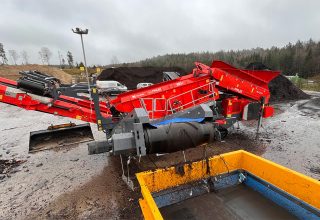
Crushing and screening give you control over particle size. Magnets and windshifter metals and light contaminants. But what do you do with materials that are the same size but have completely different densities—such as concrete mixed with wood, for example? This is where the water bath is unmatched. By taking advantage of the fact that different materials float at different depths, the technology can separate fractions that are nearly impossible to separate using mechanical or air-based methods.
The Principle: Archimedes' Principle on an industrial scale
The water bath takes advantage of the fact that materials with different densities behave differently in water. Light materials—plastic, wood, and lighter organic materials—float on the surface. Heavy materials—concrete, stone, brick, and metal—sink to the bottom. Materials in the middle can be separated depending on the settings.
This seemingly simple principle enables separations with a level of purity that is difficult to achieve by other means. The result is fractions with a purity high enough to be sold as raw materials rather than classified as waste.
Application: construction waste
Construction waste is one of the most suitable materials for water treatment. Incoming construction waste typically contains a mixture of concrete, brick, wood, plastic, and metals. After crushing and screening, there is still a mixed fraction that is difficult to process mechanically. The water bath solves this problem: the wood floats to the surface, the concrete sinks, and the plastic fraction can be collected from the surface.
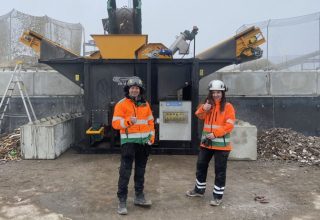
In a collaborative project with Ragn-Sells Häradsudden, Norditek demonstrated how adding a water bath the production line made it possible to sort more and cleaner fractions from construction waste—fractions that previously ended up in landfills.
Application: sand for road maintenance
When processing street sweepings, the input material often contains a mixture of sand, gravel, and organic matter. But it also includes inorganic materials such as plastic, snuff boxes, and all sorts of items discarded on our streets. Using a water bath , these water bath be separated efficiently, enabling the sand fraction to be reused for the next season. The same method is also used for similar applications instead of sending the material to a landfill.
Energy and the Environment
Water-based separation processes are relatively energy-efficient compared to thermal or chemical alternatives. The water can often be recirculated within the system, which minimizes consumption. From an environmental perspective, this technology helps keep more materials in the cycle and reduces the need for virgin raw materials.
Integration
The water bath is normally placed last or second to last in the production line—after the crusher, Screening plants and windshifter. Norditek’s modular concept allows the water bath to be integrated with other machines in the range without complicated modifications.
Summary
The water bath is one of the most effective methods for achieving the purity levels required by the materials market and regulatory standards. It is the technology that transforms mixed waste fractions into marketable raw materials. Would you like to learn more about how a water bath fit into your production line? Contact us at Norditek.