

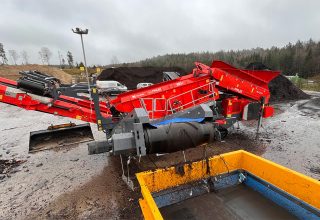
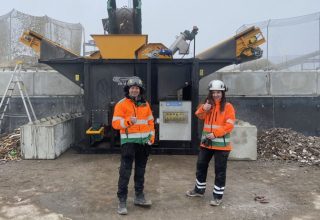
To provide more and better answers to the question of how materials that are currently often classified as waste can contain value, the Norditek Recycling Lab has been expanded. Not only does it now have a larger space for experiments, but it also features an industrial furnace, equipment, and better capabilities for conducting in-depth testing of a wider range of materials.
This means we can provide our customers with concrete answers before they make investment decisions.
Linnea is in charge of our lab and all material testing. She helps our sales representatives answer customers’ most important questions. Once we’ve worked with the customer to identify that a material has potential, we dive into the details.
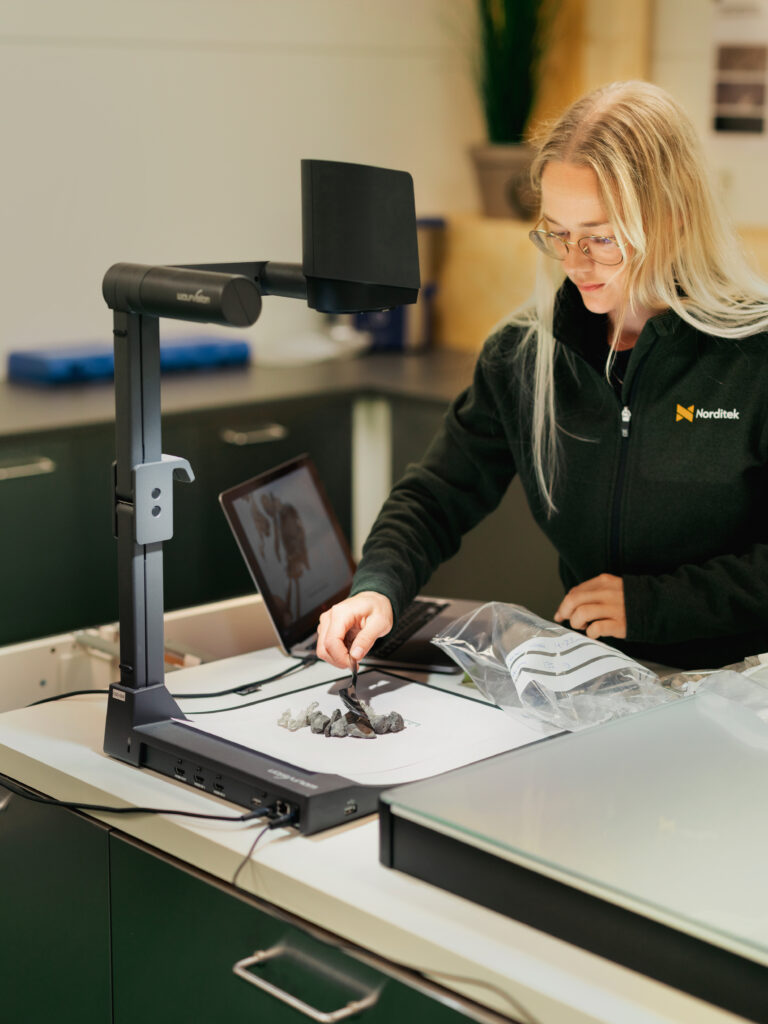
• What is the material made of?
• How does it behave?
• What can be separated?
• Which fraction has a value?
• And what solution is needed to process the material in the best possible way?
In the lab, we test our customers’ materials in detail to understand what they contain, how they react, and what technology is needed to take the next step. Because sometimes the difference between waste and raw material comes down to the right test, the right particle size, and the right combination of modules.
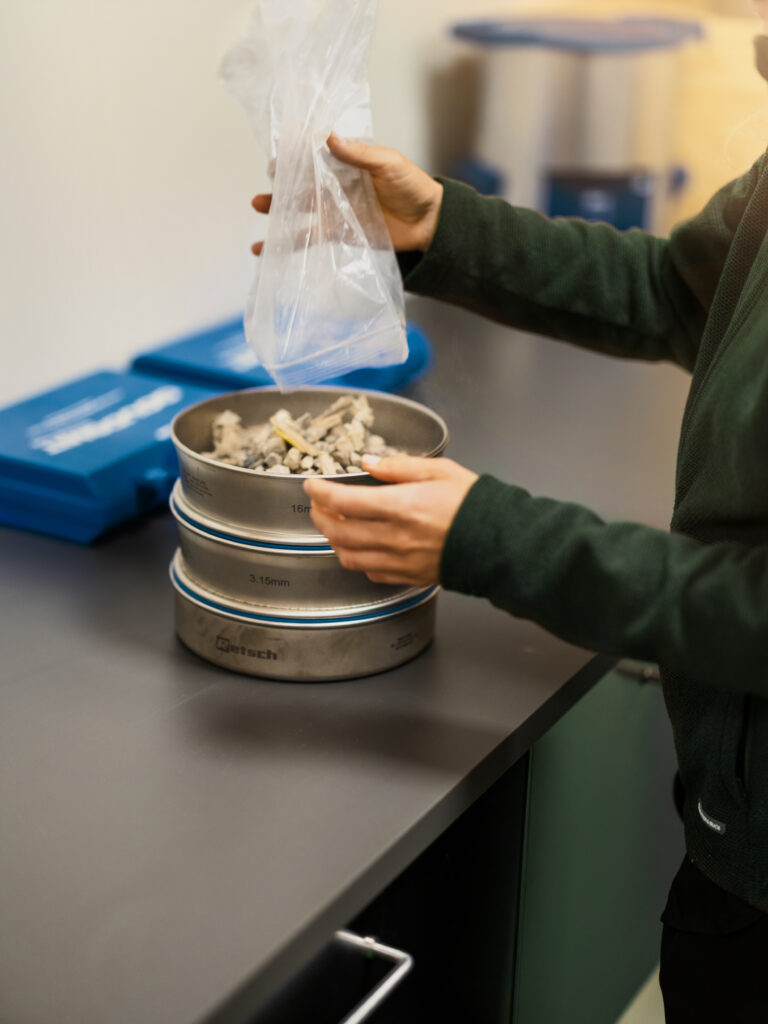
Right now, everything from construction waste, the iconic hybrid grass from Ullevi, and fiberglass to twig nuts, gypsum paper, and various types of sand is being tested. Each material has its own challenges. Rolled sand requires the right mesh size in the screen. Twig nuts need to be tested to see if they can be incinerated. With the new industrial furnace, we can investigate whether materials can be used as backfill, where the amount of organic material must be reduced to the correct level to ensure stability.
That might sound nerdy? Yep, it is. For us, however, it’s about something very concrete: helping our customers reduce uncertainty before they invest in a solution, lower opportunity costs, and find value in materials that might otherwise become an expense.
How does it work?
A material sample, weighing about 1 kg, is sent to the lab. Linnea and the salesperson decide which tests are most relevant for answering the questions about that specific material.
The results are compiled into a report that outlines the material's composition, weight, and size, as well as the available options and which modules can be combined to create the greatest possible value.
Not a guess. Not a one-size-fits-all solution. But a system based on the material’s actual composition, behavior, and potential.
Because materials can go from being a cost to a raw material, the business begins right in the lab.
Not sure about your materials?
We’re here to help you every step of the way. By analyzing a material sample, we can both identify the material’s value and determine the settings that yield the highest possible purity—and thus a higher final value.
Contact us for a material analysis today. Test first, then choose!