
The basic principle: sort materials by size
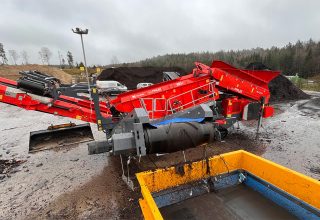
A Screening plants sometimes called a screening unit or screen—separates incoming material into different fractions based on particle size. The material is fed into the plant and passed over a screen deck with holes of defined sizes. Material smaller than the holes falls through and forms an under-fraction, while coarser material continues on as an over-fraction.
Depending on the material and the desired level of precision, different screening techniques are selected: drum screens rotate the material inside a cylinder, star screens are ideal for moist and sticky organic fractions, and flip-flow screens are highly effective for slightly tougher materials.
Flip Flow — the technology that solves the problem of hard-to-sort materials
One of the most interesting innovations in recent years is flip-flow technology. Traditional screening decks can become clogged when the material is damp, fine, or elastic. The flip-flow screen solves this by moving the screening deck in a wave-like motion at a high frequency. This lifts and tosses the material, preventing clogging and providing cleaner separation—even with difficult materials such as wet construction debris, composted food waste, or plastic-rich waste.
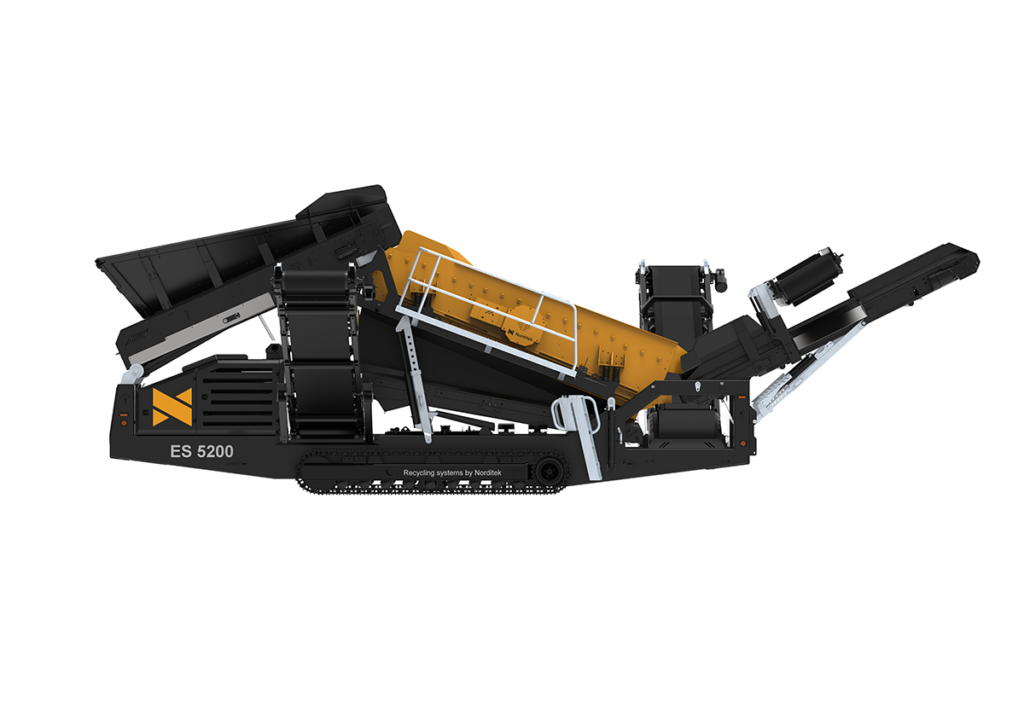
The Norditek ES5200 is an example of a modern Screening plants can be operated with either a flip-flow box or a rock box, depending on the application. The expanded screening surface produces cleaner fractions, and the smart sequence control can drive multiple modules from a single unit.
The sorting plant in the system
One of the biggest misconceptions is that the sorting plant is a standalone machine. In reality, it is a hub in our modular system. A crusher is often located upstream of the sorting plant to ensure the correct feed size. Downstream, a windshifter can windshifter light contaminants such as plastic and paper, a magnet can handle ferrous materials, and a water bath materials based on density.
The better these modules communicate with each other—mechanically, electrically, and in terms of material flow—the higher the overall recovery rate will be, and the cleaner the fractions you’ll end up with.
What should you consider when choosing Screening plants?
- What type of material will be handled? (construction waste, excavated material, organic waste, etc.)
- On average, how moist and sticky is the fraction?
- What particle sizes do you need?
- Should the machine be mobile or stationary?
- Does it need to integrate with existing modules in your system?
The correct answers to these questions determine the choice of screen type, screen area, and drive system. A design tailored to your specific material flow makes a significant difference in terms of uptime, energy consumption, and maintenance costs.
Summary
A sorting plant is not just a machine—it is a strategic investment that determines how much value you can extract from your waste streams. With the right technology, the right size, and the right integration into your system, you can increase your recycling rate, lower your operating costs, and deliver cleaner materials to the market. Want to learn more about how our Screening plants your specific operations? Contact us at Norditek —we’ll help you find the right solution.